

What are "anti-reverse current meters" and "anti-backflow meters"? Many people confuse the two, even mistakenly believing they are the same device. In fact, their definitions, functions, and application scenarios are fundamentally different. Today, we'll help you thoroughly clarify the differences.
First, let's clarify: What exactly is "anti-reverse metering"?
First, we need to correct a common misconception: "Anti-reverse metering" is not an industry standard term, but rather a colloquial abbreviation for "a meter with anti-reverse current metering function." Its core keyword is "metering control."
In simple terms, an "anti-reverse meter" is more like a "one-way bookkeeper," for example, it only recognizes "electricity sent from the grid" and not "electricity sent out by the user," and it does not have the ability to actively regulate the direction of current flow.
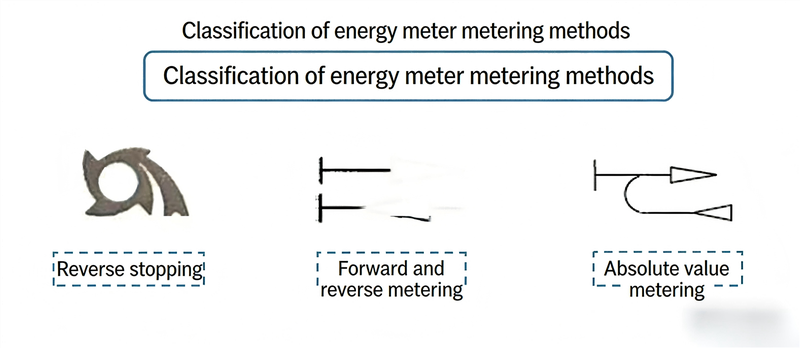
Nowadays, electronic energy meters generally adopt more reasonable and advanced forward and reverse metering in the three metering methods shown in the above pictures, and rarely use reverse check or absolute value metering.
Further Explanation: The Core Positioning and Functions of Anti-Backflow Meters
Unlike the colloquial and singular term "anti-backflow meter," the anti-backflow meter is an industry-standard term, representing a smart meter specifically designed to ensure power grid safety in the new energy era.
- In distributed photovoltaic (PV) and energy storage scenarios, when power generation exceeds local load demand, excess electricity flows back into the public grid (i.e., "reverse flow"). This can lead to increased local grid voltage, harmonic distortion, and even damage to distribution equipment, triggering relay protection malfunctions, and violating grid connection agreements.
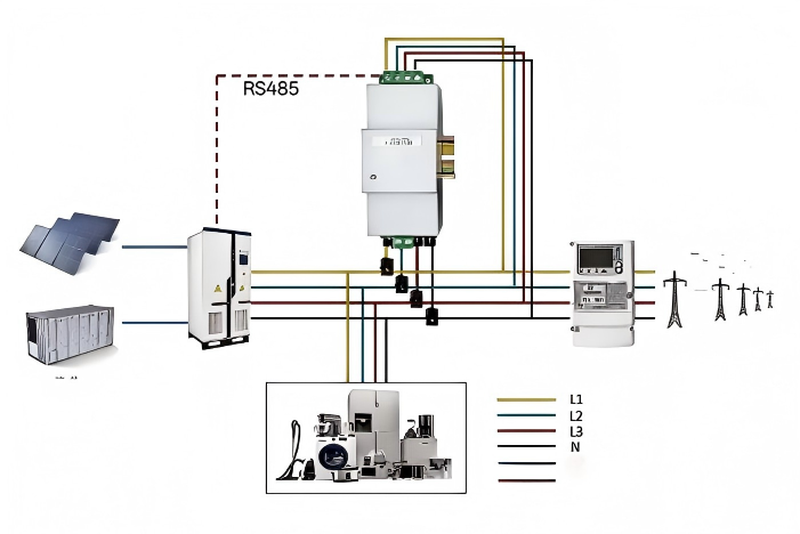
- The core function of an anti-reverse flow meter is to monitor current direction in real time. Once reverse flow is detected, it immediately takes control measures: either sending a signal to the inverter to dynamically reduce power generation until the reverse flow disappears, or directly disconnecting the grid connection circuit to completely prevent backflow and ensure grid security at its source.
In addition, anti-reverse flow meters have three core additional functions:
1. Bidirectional Metering
It can record both the electricity purchased from the grid (forward electricity consumption, used for electricity billing) and the electricity generated by renewable energy equipment (reverse generation, used for calculating power generation revenue).
2. Anomaly Warning
It monitors parameters such as voltage, current, and power in real time, and alerts maintenance personnel via local alarms or remote push notifications when anomalies occur.
3. Data Transmission
The collected power data is transmitted to the energy management platform via RS-485 communication, WiFi, and other methods, facilitating user analysis of electricity consumption and generation trends.
Key Comparison: A Table to Understand the Differences
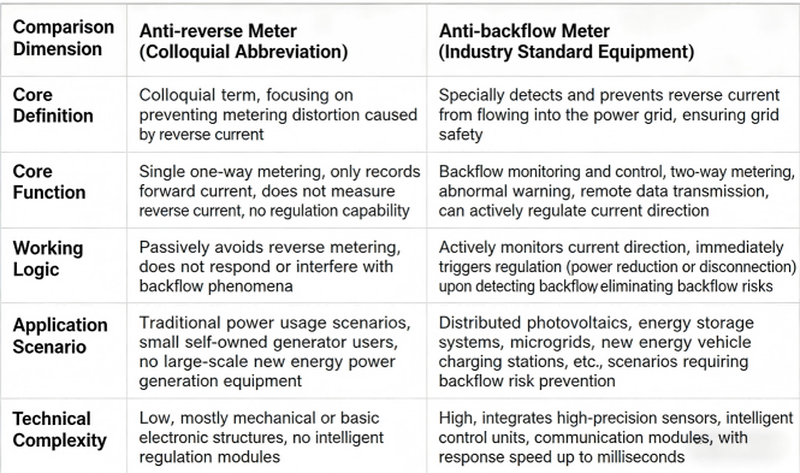
To make the distinction more intuitive, we've compared the two from key dimensions, clearly presenting their differences:
Common Misconceptions: Don't Confuse These Situations
- Misconception 1:
"Anti-reverse meter is the same as a backflow prevention meter"-Wrong! The former is a colloquial term for a "metering and control tool," while the latter is a standardized "safety control device." Their functions and roles are completely different and cannot be equated.
- Misconception 2:
"Both can solve the problem as long as there is reverse current"-Wrong! Anti-reverse meters can only "not measure" reverse current; they cannot prevent current from flowing backward and cannot solve the grid safety risks caused by reverse current. Backflow prevention meters, on the other hand, actively prevent reverse current, avoiding safety hazards at their source.
- Misconception 3:
"Installing an anti-reverse meter is enough for home solar power"-Wrong! If excess electricity is generated by home solar power, backflow can affect grid safety. Grid connection agreements in most areas explicitly prohibit disorderly backflow and require the installation of backflow prevention meters, not just simple anti-reverse meters. Otherwise, you may face warnings and grid disconnection penalties from the power grid company.
Summary
Choose according to your needs, precisely match your scenario
Simply put, the core difference between the two can be summarized as: preventing reverse current metering, and preventing reverse current metering for safety.