

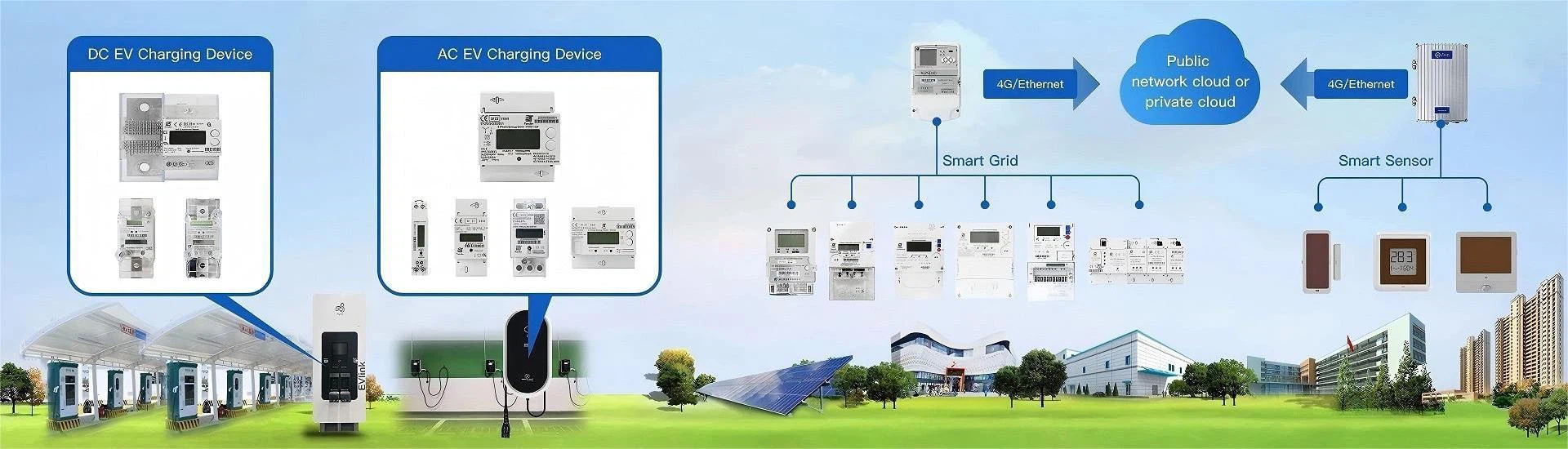
In high-precision DC power distribution fields such as photovoltaic energy storage, electric vehicle charging piles, and data centers, DC power meters are indispensable "power sentinels." The accuracy and stability of these meters depend entirely on one core indicator-how accurately they capture and measure the current flowing through the circuit.
For many veteran electrical engineers, the "shunt" is a very familiar current sampling method. However, with the rapid development of technology, new terms such as Hall effect sensors, fluxgate sensors, and even TMR (tunnel magnetoresistive) are emerging one after another.
Hall effect sensors
These sensors utilize Hall semiconductor elements to measure current by sensing the magnetic field generated around a primary conductor. This is a very popular non-contact measurement method, its biggest advantage being its inherent electrical isolation, eliminating concerns about high voltage directly impacting the downstream metering chip, resulting in extremely high safety.

Fluxgate Current Sensor
This is a technique that uses the saturation characteristics of a high-permeability iron core in an alternating magnetic field to indirectly measure weak magnetic fields.
Its characteristics are very distinct: extremely high accuracy and minimal temperature drift, making it frequently used in high-precision DC detection, electrical insulation monitoring, and metrological calibration. However, its disadvantages include high cost and relatively slow response speed.
TMR sensors, etc.
TMR stands for Tunnel Magnetoresistance. Simply put, it is a high-precision magnetic sensor based on magnetoelectronics. Its core is the use of a nanoscale sandwich structure of "ferromagnetic layer/non-magnetic insulating layer/ferromagnetic layer" to achieve precise conversion of magnetic signals to electrical signals through electron spin.

The "Moat" of Shunts: Why Can't These Technologies Shake Its Dominance?
Given the high-tech and powerful capabilities of Hall effect sensors and fluxgate magnets, why is the shunt, which looks like a copper bar or resistor, still the most common and trusted shunt in the market? The answer lies in its four core advantages:
Unparalleled Measurement Accuracy and Linearity
Regardless of how peripheral technologies evolve, the laws of physics remain the most honest. The working principle of a shunt is extremely pure-Ohm's Law. Because it is essentially a precision manganese-copper resistor with an extremely low temperature coefficient, its resistance-current change curve is almost a perfect straight line, exhibiting exceptional linearity and very small nonlinear errors.
In contrast, Hall elements are affected by the magnetic circuit, resulting in slight nonlinear offsets, while fluxgate magnets exhibit response hysteresis. As industry experts have pointed out: if the accuracy of current measurement is the primary criterion, then a shunt resistor solution paired with a precision millivolt transmitter is always the best choice.

Ultimate Cost-Effectiveness and High Reliability
While Hall effect and fluxgate sensors offer a wealth of functionality, they require complex iron cores and coils, as well as secondary power supplies and intricate compensation circuits. Especially in the DC energy meter market, some high-precision closed-loop Hall effect sensors can cost five to ten times more than ordinary shunt resistors.
In contrast, shunts are extremely simple in structure, purely passive devices, and operate reliably without additional power, making them exceptionally robust and durable. In the cost-sensitive civilian DC energy meter and charging station market, the cost-effectiveness of shunts represents a significant advantage that even complex sensors struggle to overcome.
Powerful Over-Range Capability and Ultra-Wide Temperature Adaptability
In real-world industrial environments, instantaneous currents often far exceed rated values. Shunt units demonstrate remarkable resilience in this regard. For example, a high-precision shunt unit on the market can easily handle instantaneous surge currents tens of times higher than its rated value across a full temperature range of -40℃ to +105℃, without compromising sampling accuracy.
In contrast, sensors based on magnetic principles are highly susceptible to core saturation or high-temperature demagnetization when the current is too high, leading to measurement distortion or even permanent equipment damage.

Extremely Strong Resistance to Electromagnetic Interference
While Hall effect and fluxgate magnetometer sensors achieve elegant non-contact measurement, in environments with strong magnetic fields and high-frequency interference (such as near high-power inverters or high-current busbars), stray magnetic fields can easily infiltrate the detection signal, causing unpredictable measurement errors.
In contrast, shunt converters are pure circuit direct series sampling devices. They are only loyal to the voltage drop across their own resistance, and are virtually unaffected by external stray electromagnetic fields. This makes them particularly reliable in complex electromagnetic compatibility (EMC) cabinets.