

Charging Pile Module: The Core Decisive Factor for Level 1 Energy Efficiency
The overall energy efficiency of a charging pile is determined by the combined efficiency of all its internal components. The core calculation formula can be simplified to: Overall Pile Energy Efficiency = Module Efficiency - Power Consumption of Other Components.
Therefore, the charging module plays a decisive role in the overall energy efficiency of the charging pile-module efficiency is always higher than overall pile efficiency; the higher the module efficiency, the higher the overall pile energy efficiency.
Compared to the charging module, the technologies of other components such as contactors, auxiliary power supplies, cables, and connectors are relatively mature, and loss control is nearing its limit, making it difficult to significantly improve energy efficiency through these components. Furthermore, line losses from copper busbars and charging cables are inherent losses and cannot be completely eliminated.

Therefore, to fundamentally improve the overall energy efficiency of a charging pile and achieve the Level 1 energy efficiency standard, the focus must be on improving the efficiency of the charging module.
According to the new national standard, the weighted efficiency of a charging pile with Level 1 energy efficiency must be ≥96.5%. However, charging piles have inherent losses, mainly categorized into three types, totaling approximately 0.5% based on the lowest loss and approximately 0.7% on the highest:
| Loss Type | Detailed Description | Loss Proportion Range |
|---|---|---|
| Transmission Loss | Voltage drop of copper busbars, wiring harnesses, charging cables, etc. | Approx. 0.25-0.3% |
| Operating Loss | Operating consumption of equipment such as fans, auxiliary power supplies, and screens | Approx. 0.2-0.3% |
| Component Loss | Internal loss of components such as fuses and contactors | Approx. 0.06-0.1% |
Based on the above calculation of inherent losses, the module efficiency must meet the following requirements: Module efficiency = Level 1 energy efficiency baseline for the entire pile (96.5%) + Minimum inherent loss (0.5%) = 97%. It should be noted that 97% module efficiency is only a basic threshold. If the module efficiency is lower than 97%, it is almost impossible for the entire pile to achieve Level 1 energy efficiency. Even if it reaches 97%, other losses must be controlled to ensure that the entire pile ultimately meets the standards.
Table 1 Energy Efficiency Grades of Integrated DC Power Supply Equipment
| Product Type | Energy Efficiency Grade | |||||
|---|---|---|---|---|---|---|
| Grade 1 | Grade 2 | Grade 3 | ||||
| Charging Efficiency (%) | Standby Power Consumption (W) | Charging Efficiency (%) | Standby Power Consumption (W) | Charging Efficiency (%) | Standby Power Consumption (W) | |
| Integrated DC Power Supply Equipment | 96.5 | 30.0 | 95.5 | 30.0 | 94.5 | 30.0 |
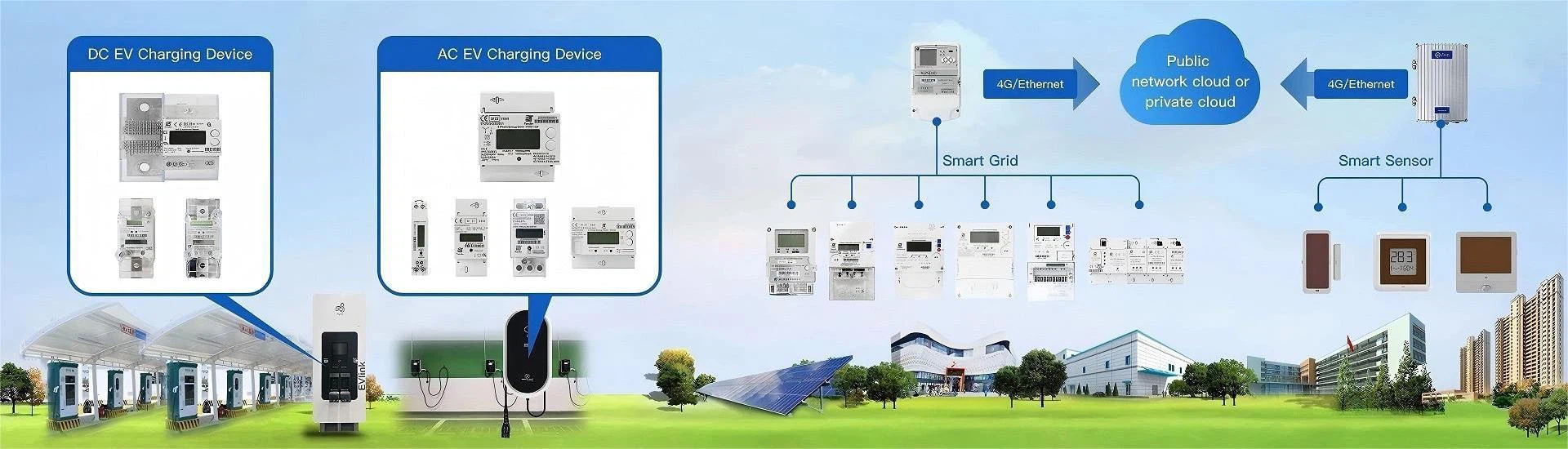
Integrated DC meter: Helps the entire pile achieve Level 1 energy efficiency standards
Besides the charging module, the type of DC energy meter also affects the overall energy efficiency of the charging pile. Among them, integrated shunt DC energy meters offer significant advantages over traditional external shunt DC energy meters in reducing losses and helping to meet energy efficiency standards.

Taking a common 75mV shunt as an example, let's compare the differences in power consumption and losses between the two types of DC energy meters:
Power Consumption Comparison
At 300A current, the theoretical power consumption of an externally connected shunt DC energy meter is P = 300A × 75mV = 22.5W; while the theoretical power consumption of an integrated shunt DC energy meter is only P = 300A × 6mV = 1.8W, a difference of 20.7W, indicating a significant reduction in power consumption for the integrated meter.
Loss Comparison
When the charging pile outputs 750V and the shunt reaches its maximum current, the voltage drop of the externally connected shunt is 75mV, resulting in a loss of approximately 0.01%; under the same conditions, the loss generated by the integrated shunt DC meter is only 0.0008%, which is almost negligible.
Integrated DC Charging Pile Meter
Due to its advantages of low power consumption and low loss, along with its ease of installation, anti-interference capabilities, and high accuracy, the integrated shunt DC energy meter has become the preferred choice for new high-end DC charging piles, further contributing to achieving Level 1 energy efficiency for the entire charging pile.