

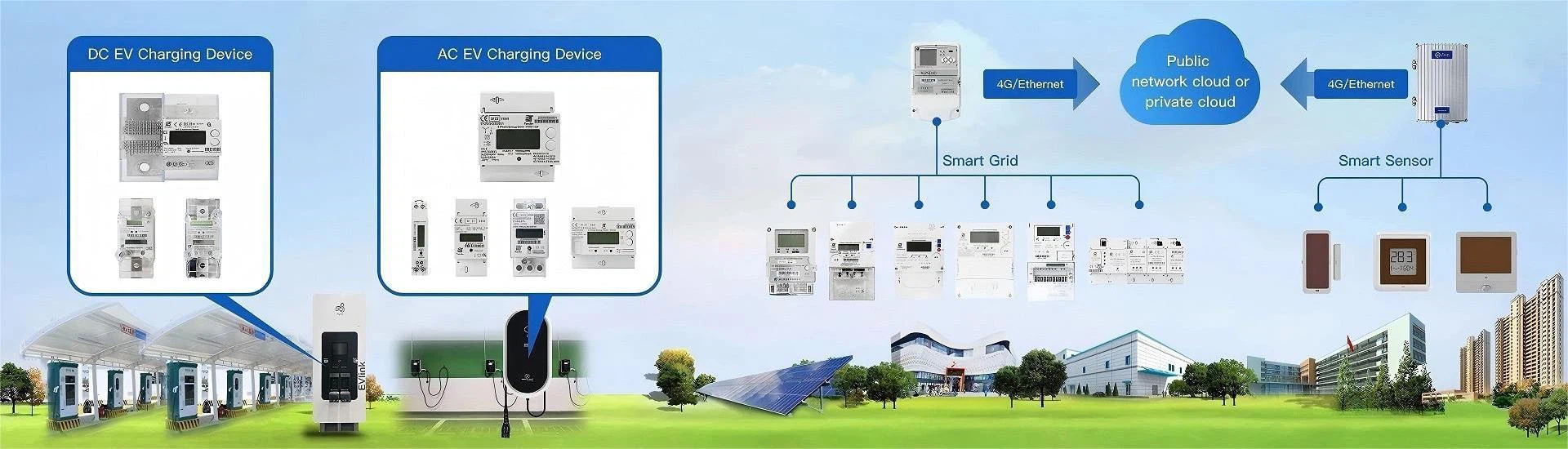
With "dual carbon" goals becoming the main theme of development, accurate carbon emission measurement has become crucial for green and low-carbon transformation. Electric carbon meters transform previously "invisible and intangible" carbon emissions into real-time, visible data streams, becoming the "digital hub" for enterprises' low-carbon production.
Many people wonder, what's the difference between an electric carbon meter and a regular smart meter? Essentially, an electric carbon meter is a new type of metering device based on electricity consumption and carbon emission factor calculation. While its appearance is similar to a regular meter, its core has been upgraded. It not only measures electricity consumption but also displays carbon emissions in real time. The core principle can be summarized by a simple formula: Real-time electricity consumption data × Dynamic carbon factor = Accurate carbon emissions.

Its operating logic is not complex. First, it collects real-time electricity consumption data from users. Then, combined with dynamic carbon emission factors transmitted from upstream nodes, it automatically calculates real-time carbon emissions and uploads this data to the carbon metering and monitoring platform. Through the layered transmission of dynamic carbon emission factors, it ultimately achieves accurate metering of user-side electricity carbon emissions, making the carbon emissions of each kilowatt-hour as intuitive and transparent as electricity consumption.
The key to this-the dynamic carbon emission factor-is not a fixed value, but rather determined in real-time by the proportion of power supply in the power grid. The system updates the carbon emission factor across the entire "production-transportation-consumption" chain, i.e., the carbon emissions per kilowatt-hour, based on the proportion of various power sources such as thermal power, wind power, and photovoltaic power.

What is the carbon emission factor?
Definition: The amount of carbon dioxide emitted per unit of energy consumption or product production process.
Core Function: To aid in the calculation and prediction of carbon emissions.
Why is the carbon emission factor dynamic?
Differences in power generation structure: Carbon emission factors vary significantly depending on the power generation method. As the proportion of renewable energy (hydropower, wind power, solar power, etc.) increases, the overall carbon emission factor of the power system decreases.
Changes in energy mix over time: The energy structure in the power system changes dynamically over time. For example, wind power output may increase at night, while solar power output is higher during the day, resulting in different carbon emission factors at different times.
With a carbon meter, how can accurate measurement of carbon emissions be achieved?
Core Calculation Formula
User-side carbon emissions = Upper-level node carbon emission factor (dynamic) × Electricity consumption
Transmission Flowchart
Dynamic carbon emission factor transmission link: Power supply side → Grid side → Carbon metering and acquisition master station (monitoring platform, data visualization)
User-side metering link: Electricity consumption → Carbon meter (user side) → Combined with upper-level node carbon emission factor → Data back to carbon metering and acquisition master station
For example, as the proportion of clean energy power generation such as wind and solar power increases, the carbon emission factor per kilowatt-hour decreases; conversely, as the proportion of thermal power increases, the factor increases. This compensates for the shortcomings of traditional fixed-factor estimation, making carbon metering more closely aligned with actual electricity consumption scenarios.

Electric carbon meters link carbon emission data to production electricity consumption in real time, becoming a "carbon steward" for enterprises. For companies where electricity consumption accounts for the majority of carbon emissions, electric carbon meters are not only a metering tool but also a crucial lever for promoting low-carbon production.
However, it is important to note that electric carbon meters are only an important innovation in carbon metering, not a panacea. Carbon emissions from industries such as steel, cement, and chemicals involve complex pathways beyond electricity consumption, including fuel combustion and chemical reactions; carbon emission sources in industries such as building materials and papermaking are more dispersed, and these cannot be covered by electric carbon meters alone.

In the future, with the continuous improvement of the carbon metering system, energy conservation and emission reduction may shift from passive compliance by enterprises to proactive "carbon economy" decision-making that optimizes production factors, laying a solid data foundation for achieving "dual carbon" goals.