

In power metering and monitoring systems, electricity meters that require external current transformers (CTs) are ubiquitous; they are our "eyes" for accurately sensing massive currents. However, hidden within this sophisticated system is an ironclad rule that must be followed at all times: the secondary side of the current transformer must never be operated with an open circuit. This article will delve into the underlying principles and the dangers involved.
Normal Operating Principle of Current Transformers
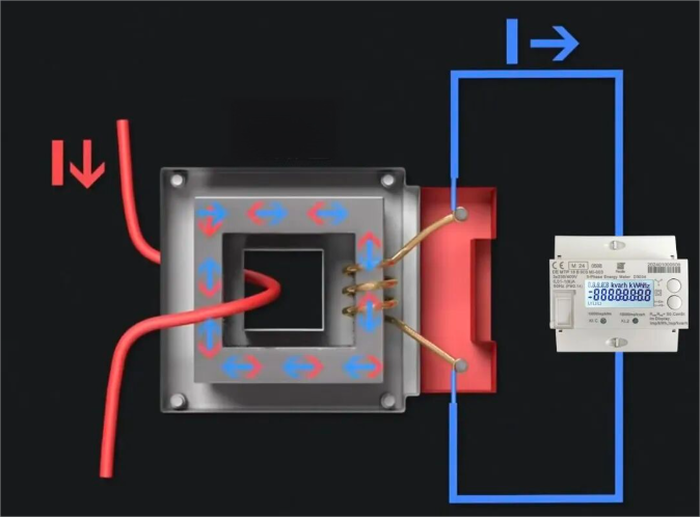
A current transformer (CT) is a special type of transformer that operates based on the principle of electromagnetic induction. Its core design principles are "current reduction" and "isolation."
Structure
It typically consists of a closed iron core, a primary winding with a relatively small number of turns (connected in series in the main circuit), and a secondary winding with a relatively large number of turns (connected to the electricity meter).
Ideal State
In a normal closed circuit, the CT operates in an approximately "short-circuit" state. According to Ampere's circuital law and the law of electromagnetic induction, the primary current I1 will generate an alternating magnetic flux Φ in the iron core, which in turn induces a current I2 on the secondary side. The relationship between the two is:
I1 × N1 = I2 × N2 + Im × N1
Where N1 and N2 are the number of turns in the primary and secondary windings, and Im is the excitation current. Due to the large excitation impedance in the design, Im is extremely small, so in an ideal state, it can be simplified to:
I₁ × N₁ ≈ I₂ × N₂ or I₁/I₂ ≈ N₂/N₁ = Kₙ
Here, Kn is the rated turns ratio, for example, 1000/5A. At this time, the large current on the primary side is accurately converted proportionally into a small current on the secondary side (usually a standard value of 5A or 1A) for safe measurement by instruments. Simultaneously, the potential of the CT's secondary circuit is very low (usually only a few volts), within a safe range.
Principle Analysis of Secondary Circuit Open Circuit
When the secondary circuit becomes open due to reasons such as loose terminals, broken wires, or accidental disconnection during testing, its operating state undergoes a catastrophic change.
| Working Status | Normal Closed | Secondary Open Circuit |
|---|---|---|
| Secondary Current I2 | Exists, proportional to I1 | I2=0 |
| Core Magnetic Flux Φ | Effectively suppressed by the demagnetizing flux generated by I2, maintained at a low level | Loses suppression, rapidly saturates to an extremely high value |
| Secondary Voltage U2 | Very low (several volts) | Induces high voltage of thousands to even tens of thousands of volts |
| Physical Essence | Strong coupling, deep negative feedback: I2 strongly resists the change of Φ | Feedback cut-off, energy accumulation: All primary ampere-turns I1N1 are used for excitation |
The core physical process is as follows:
Disappearance of Demagnetizing Feedback
During normal operation, the magnetic flux generated by the secondary current I2 is always in the opposite direction to that generated by the primary current I1, creating a strong "demagnetizing" effect that confines the combined magnetic flux in the core to a low level. After the circuit is opened, I2 = 0, and the demagnetizing effect instantly returns to zero.
Rapid Saturation of Magnetic Flux
The primary ampere-turns I1 and N1, now unrestrained, are entirely converted into magnetizing ampere-turns. Since the core cross-sectional area is designed for low magnetic flux density, the core rapidly enters a deep saturation state.
According to Faraday's law of electromagnetic induction, alternating magnetic flux induces an electromotive force across the winding. When the magnetic flux increases dramatically, an extremely high voltage U2 will be induced across the secondary winding.

Generation of High Voltage
Under power frequency conditions, for a primary current of several hundred amperes, the induced voltage on an open-circuit secondary side can easily reach several thousand volts, and in extreme cases, exceed 10 kilovolts.
Hazards of Open Circuit on Secondary Side of Current Transformer
The high voltage and accompanying phenomena generated by an open circuit in the secondary side can trigger a series of chain reactions of hazards.
Danger of Electric Shock
The presence of thousands of volts of high voltage at the secondary terminals directly constitutes a serious risk of electric shock. Maintenance and repair personnel who come into contact with this voltage without precautions may suffer electric shock.
Equipment Damage
Insulation Breakdown: High voltage will first break down the inter-turn and inter-layer insulation of the secondary winding, or break down the insulation to ground in the secondary circuit, leading to permanent damage to the current transformer (CT).
Overheating and Burnout: When the iron core is highly saturated, it will generate huge eddy currents and hysteresis losses, causing the iron core to overheat, which may burn out the winding insulation and even cause a fire.
Electric Arc and Explosion: An open circuit point (such as a loose terminal) will generate a continuous electric arc under high voltage. The high temperature of the arc may burn out the equipment, ignite surrounding combustibles, and the high-temperature gases accumulated in the sealed cabinet may even cause an electrical explosion.
System Operation Hazards
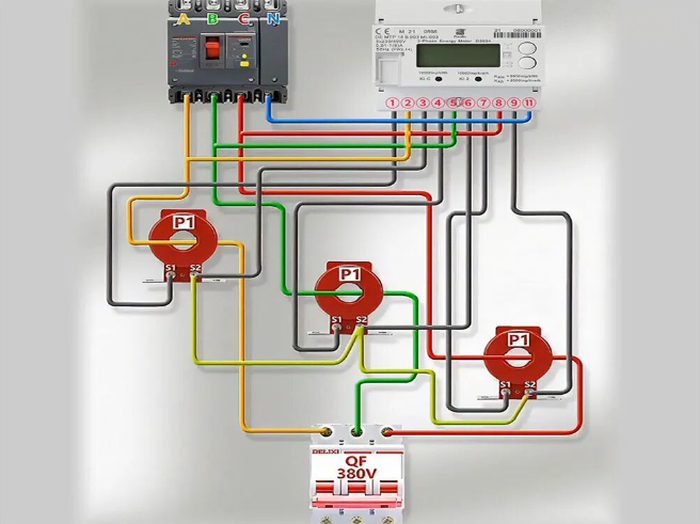
Metering Inaccuracy and Failure: For CT-type energy meters, a zero input current will render them unable to measure electricity, resulting in lost electricity and potential trade settlement disputes.
Generation of Dangerous High-Voltage Sparks: This is not only an ignition source, but the resulting strong electromagnetic pulses can also interfere with nearby electronic equipment.
Conclusion
An open circuit on the secondary side of a current transformer triggers a violent accumulation of electromagnetic energy, ultimately resulting in a physical catastrophe manifested as high voltage, strong electric arcs, and overheating. Therefore, "preventing open circuits" must be strictly adhered to in all work involving CT circuits.
Simultaneously, the secondary side of the current transformer connected to the electricity meter must be grounded. This, along with "strictly prohibiting open circuits on the secondary side," are two core ironclad rules of CT operation and maintenance. Grounding allows any high voltage surges to be quickly discharged to the ground via a grounding wire, preventing sudden increases in secondary potential that could lead to equipment burnout or electric shock accidents.