

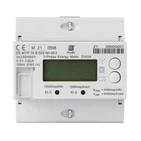
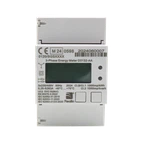
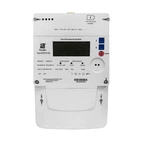
In the power supply circuits of every household and enterprise, the electricity meter is an indispensable "electricity management tool" that accurately records the consumption trajectory of each kilowatt-hour of electricity. Careful users may notice a detail: electricity meters installed in different years have significantly different marking methods for current parameters-older meters are mostly marked with 5(60)A, while newly replaced ones are often marked with 0.25-0.5(60)A. This change in numbers is not arbitrary by manufacturers, but a direct reflection of the iterative upgrade of China's electricity meter metering standards, behind which lies the unremitting pursuit of metering accuracy and transparency.
Traditional Marking Method: Simplicity and Implied Logic of 5(60)A
During the implementation period of the national standard GB/T 15283-94 (equivalent to the international standard IEC 521-1988), 5(60)A was the mainstream marking method for electricity meter current specifications. This marking method has been used for decades and has become a common memory for a generation of users. To understand its meaning, two core parameters need to be analyzed: the 5A in front is called the calibrated current (also known as the basic current, symbol Ib), which is the "reference coordinate" for the metering characteristics of the electricity meter.

The core function of the calibrated current is to define the metering reference of the electricity meter. The starting current of the meter (the minimum current that can drive the meter to start counting) is directly related to it-for common Class 2 accuracy meters, the starting current is about 0.5% of the calibrated current. For a 5(60)A meter, theoretically, it can start metering at a current of 0.025A. The 60A in parentheses is the rated maximum current (symbol Imax), which represents the upper limit of current that the meter can operate safely for a long time while maintaining accurate metering. When the actual operating current of a household or enterprise does not exceed this value, the metering error of the meter will be controlled within the range allowed by national standards, with an error of no more than ±1% for Class 1 meters and no more than ±2% for Class 2 meters.
The advantage of this traditional marking method lies in its simplicity and intuitiveness. Ordinary users only need to know that the maximum current does not exceed the value in parentheses to use electricity safely. Its limitations are also obvious: key parameters such as minimum metering current and transition current are not directly marked and need to be derived by professionals through formulas, which sets a threshold for ordinary users to understand the metering characteristics of the electricity meter.
New National Standard Marking Method: Precision and Transparent Innovation of 0.25-0.5(60)A
With the maturity of electronic electricity meter technology and the diversification of electricity consumption scenarios, the limitations of the traditional marking method have become increasingly prominent. For this reason, China has successively issued a series of new specifications such as GB/T 32856-2016, and finally established a new current marking method such as 0.25-0.5(60)A. The latest standard GB17215-2021 further clarifies this marking requirement. The new marking method seems complicated, but it actually achieves "full transparency" of metering parameters, with each of the three values having a clear role.
The 0.25A in the new marking is the minimum current (Imin), which is the "lower threshold" for the meter to maintain accurate metering. Below this current value, the metering error of the meter may exceed the standard requirements; the 0.5A in the middle is the transition current (Itr), which is the "stable critical point" of the meter's metering accuracy. When the operating current reaches or exceeds this value, the metering error of the meter will be strictly stabilized within the maximum allowable range specified by national standards, and Class 1 meters can usually be stabilized within ±1%; the final 60A is still the rated maximum current (Imax), whose meaning is exactly the same as that of the traditional marking method, ensuring the upper limit of electricity safety and metering accuracy.
The innovative value of the new marking method is particularly evident in light-load scenarios. In modern households, there are more and more low-power devices such as standby mobile phone chargers, always-on routers, and dormant smart home appliances. The standby power consumption of such devices is usually only 1-5 watts, which is equivalent to a current of about 0.0045-0.023A. If the minimum current of the meter is too high, it may not accurately measure these "invisible power consumption", causing users to feel that "electricity bills have increased inexplicably". The new marking directly indicates the minimum current, allowing users to clearly judge whether the meter can accurately capture light-load consumption and eliminating metering misunderstandings at the source. The DDSF1226 single-phase electronic electricity meter produced by UBS Electronics once adopted a dual marking design of old and new standards, becoming an intuitive witness to the transition between the two standards.

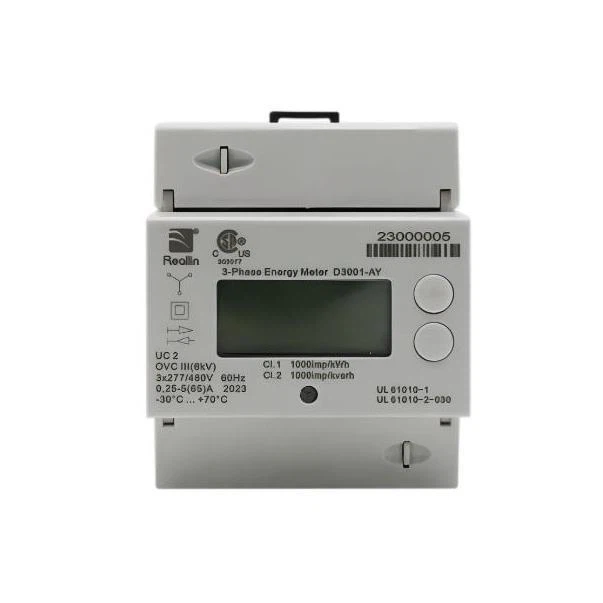
Old and New Standards: Accuracy Upgrade Without Changing Performance
Many users are worried that the meter with the new marking will "run faster", which is a misunderstanding of the standard upgrade. It is worth emphasizing that the old and new marking methods do not change the core metering performance of the electricity meter, but only optimize the way parameters are presented. Taking common single-phase meters as an example, the minimum current deduced from the calibrated current of the old 5(60)A meter is about 0.25A, and the transition current is about 0.5A, which is completely equivalent to the core parameters of the new 0.25-0.5(60)A marking. The only difference is that the new marking directly "displays" these implied parameters to users.
From the perspective of industry development trends, the promotion of the new marking method is an inevitable choice to align with international standards. The current national standard clearly requires the priority adoption of the new marking method. Even more refined markings such as 0.2-0.5(60)A have appeared in three-phase meters, further improving the controllability of metering accuracy. Behind this change is China's conceptual upgrade from "meeting basic metering" to "pursuing full-range accurate metering", which protects the right to know of users and provides more reliable metering support for new electricity consumption scenarios such as new energy access and smart home popularization.
With the advancement of meter replacement work, electricity meters with new markings such as 0.25-0.5(60)A have become increasingly popular. When we look at our home electricity meter again, this set of numbers is no longer cold parameters, but a microcosm of the progress of metering technology, and more importantly, an accurate guarantee for the electricity consumption rights and interests of every user. Understanding the meaning of these parameters can help us better manage electricity consumption and more clearly understand the standardized development path in the field of electric power metering.