

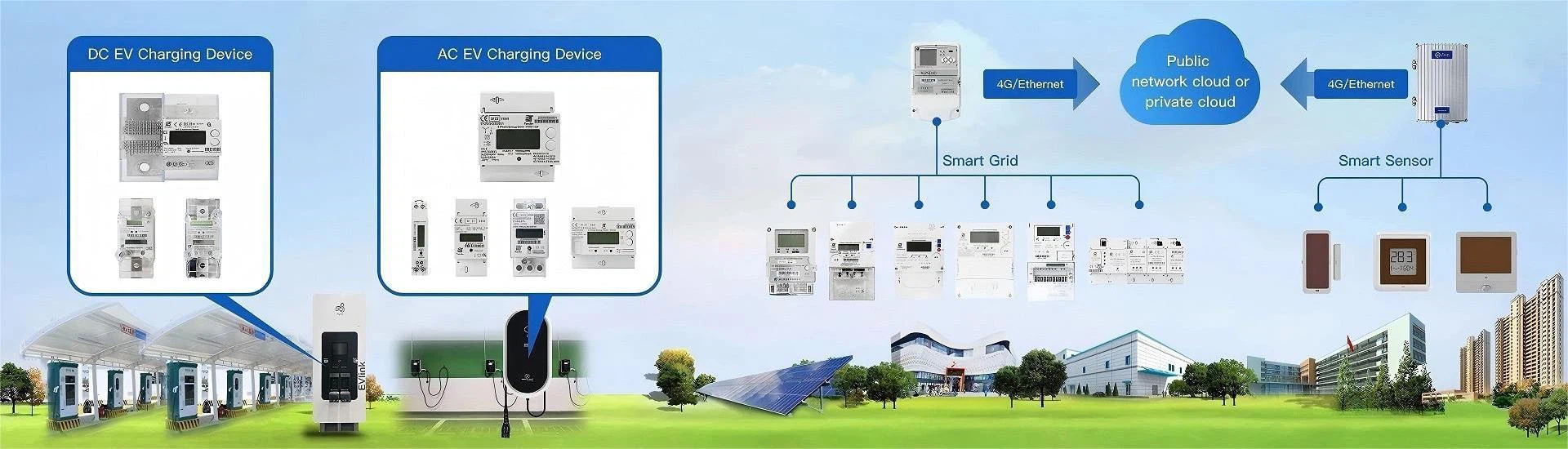
In today's era of widespread smart grids, electric meters are no longer just "power-tracking metal boxes"-they're the core nodes of electricity data collection, and smart meter interfaces plus meter communication protocols are the keys to ensuring meters "speak the grid's language and transmit data accurately." This article breaks down global mainstream meter interfaces, Modbus-RTU protocol applications, and why RS485 is the top choice for meter communication.
The "Data Transmission Imperative" for Meters
As the backbone of electricity metering equipment, meters must not only record power usage precisely but also deliver data reliably to remote meter reading systems and power monitoring platforms-much like a package needs both a "delivery route" and "address rules." A meter's RS485 interface is the "physical route" for data, while Modbus protocols are the "digital rules" for interaction.
If interfaces are like "cities," protocols are the "languages spoken there": only when both sides use the same meter interface and protocol can data be correctly identified and parsed. Globally, meter interfaces and protocols have converged into mainstream standards, with RS485 for smart meters leading in adoption, and protocols split between "industrial universal" and "power-specific" categories.
Global Mainstream Meter Interfaces: Why RS485 Is the "Go-To Choice"
Meter interface design must balance stability, anti-interference, cost, and compatibility. Today's global smart meter interfaces fall into several categories, and RS485 interfaces account for over 70% of deployments-making them the undisputed "dominant option."
RS485 Interface: The "Universal Channel" for Meters
RS485 is the most widely used meter interface globally-especially in China, where it's the most popular wired interface for smart meters, covering over 90% of residential and industrial meters.
Its core advantages perfectly fit centralized meter reading system scenarios:
- Long transmission distance: Uses differential signaling to reach up to 1200 meters, easily covering meter clusters in entire residential buildings or large factories.
- Strong anti-interference: Resists electromagnetic and common-mode interference in power systems, ensuring stable meter data transmission even in complex electrical environments.
- Multi-device compatibility: A single bus connects up to 128 meters (multi-drop capability), drastically reducing wiring costs for smart grid meter reading systems.
- Cost-effective: Mature technology and low hardware costs make it ideal for large-scale meter deployments.
These traits make RS485 the "optimal solution for residential community metering and industrial meter data collection"-for example, a single RS485 bus can collect data from dozens of meters in a residential building.


Other Meter Interface Types
Beyond RS485, meters use other interfaces for niche needs:
- Infrared (IrDA): A "flexible choice for short-range meter reading," typically a modulated infrared interface used for on-site handheld devices to read single-meter data or configure settings (e.g., property staff using a terminal to collect data locally).
- Ethernet (RJ45): The "high-speed channel" for smart grids, only included in high-end networked power meters. It supports TCP/IP, connects directly to local area networks, and enables millisecond-level high-speed transmission-ideal for industrial power monitoring systems with strict real-time requirements.
- Wireless interfaces:Solutions for remote meter deployments (remote/scattered locations):
NB-IoT/LoRa: Low-power, wide-coverage, and network-independent; battery-powered units operate for years, perfect for rural smart meters or streetlight meters (scattered, hard-to-wire areas).
Wi-Fi: Fast transmission but high power consumption, suited for commercial building meters (stable power, short-range).
4G: Leverages mobile carrier networks for broad coverage and real-time remote meter reading, ideal for suburban scattered meters.
- Niche interfaces:
RS232: Limited to 15-meter point-to-point transmission; largely replaced by RS485, only used for legacy meter debugging.
USB: For local data export or configuration-not for remote reading.
Global Mainstream Meter Protocols: The "Common Language" of Data Transmission
Interfaces are the "channel," but protocols are the "language"-even with matching interfaces, mismatched meter communication protocols turn data into "gibberish." Today's global smart meter protocols split into "industrial universal" and "power-specific" types.
Industrial Universal Protocols: The "Base Language" for Cross-Device Compatibility
These protocols let meters communicate with industrial equipment (PLCs, monitoring systems), with the Modbus protocol family as the global leader.
Modbus-RTU: RS485's "Gold Partner"
Modbus-RTU is the most widely used meter protocol globally-nearly a "standard match" for RS485. This pairing holds over 70% of the global meter communication market.
Its key benefits:
- Simple structure: Clear data frames make meter data parsing easy.
- Open-source & free: No licensing fees; supported by all meter reading devices, PLCs, and monitoring systems.
- High compatibility: Works with almost all RS485-equipped domestic or imported smart meters.
- Optimized for mid-low speed: Perfect for power usage data collection or parameter reading (no bandwidth waste).
For example, residential centralized meter reading systems use "RS485 bus + Modbus-RTU" to collect data from dozens of meters via a single line.

Modbus-TCP: The "High-Speed Language" for Ethernet Meters
This Ethernet-compatible Modbus variant works with RJ45 interfaces and TCP/IP, enabling high-speed transmission-critical for smart grid real-time monitoring systems that need millisecond-level meter data.
Power-Specific Protocols: "Specialized Languages" for Meters
Industrial protocols excel at universality, but power scenarios have unique needs (billing, event logging), so regions have developed power-specific meter protocols:

-
DL/T 645 & DL/T 698: China's Mandatory Standards
These national standards are required for domestic smart meters, designed for "electricity metering," "cost control," and "event logging."
They're tailored to Chinese power operations (e.g., tiered pricing, prepayment cutoffs, fault alerts) and often paired with RS485 + Modbus-RTU: meters use DL/T 645 internally for power tasks, then communicate with meter reading systems via Modbus-RTU.
-
IEC 62056: Europe's "Open Protocol"
Also called "DLMS/COSEM," this European standard prioritizes openness-it supports multiple interfaces (RS485, infrared, Ethernet) and works with diverse meter brands/types, making it ideal for cross-border power project meter communication (e.g., European cross-grid data sharing).
-
M-BUS: The "Network Protocol" for Multi-Meter Systems
M-BUS networks water, electric, and heat meters, supporting 1000-meter transmission. Paired with RS485, it powers "community multi-meter integrated reading systems" (e.g., property staff collecting electric/water data via one system).
-
IEC 61850: The "High-End Protocol" for Smart Grids
A core smart grid protocol for substations and high-voltage meters, it enables "real-time high-volume data transmission" and "device-to-device automation"-e.g., a faulty substation meter can auto-alert the control center via IEC 61850, making it the future "high-end protocol direction" for premium smart meters.
Wireless-Specific Protocols: "Exclusive Languages" for Remote Meters
Wireless meters use dedicated protocols:
- MQTT: A lightweight IoT protocol for NB-IoT/LoRa; low-power and compact, perfect for remote meter reading (battery-powered units).
- 4G Protocols: Leverages mobile TCP/UDP for high-throughput, real-time transmission-ideal for remote area smart meters to upload data live.
UTP Meter Interfaces & Protocols: Mainstream Solutions in Practice
As a domestic meter manufacturer, UTP's interface/protocol choices align with global smart meter standards:
RS485 as the core interface: Its maturity, reliability, and low cost make it the default for UTP's wired smart meters.
Scenario-tailored protocols:
- Domestic AC meters: DL/T 645/698 (plus Modbus-RTU) for domestic power operations.
- Domestic DC meters (integrated shunt): DL/T 645/698 (nearly all support Modbus-RTU).
- Overseas DC meters (integrated shunt): SLIP protocol (adapted to foreign network environments).
- Overseas AC meters: Modbus-RTU (compliant with global universal meter communication standards).

The Dominance of RS485 + Modbus-RTU
Today's global smart meter mainstream configuration is RS485 + Modbus-RTU-this pairing's "stability, low cost, and high compatibility" give it over 70% of the global market, with no short-term replacement in residential or industrial low-voltage meter sectors.
Future trends will "dual-track":
- Wired direction: RS485 + Modbus-RTU/IEC 62056 remains dominant for traditional centralized reading and industrial monitoring.
- Wireless direction: NB-IoT/LoRa + MQTT or 4G are rising as the top choices for remote area meters and new community meters, driving "wireless, intelligent" meter upgrades.
From interfaces to protocols, meter communication evolves around "reliability, efficiency, and low cost"-these small technical details are the backbone of stable power system operation and accurate data transmission.