

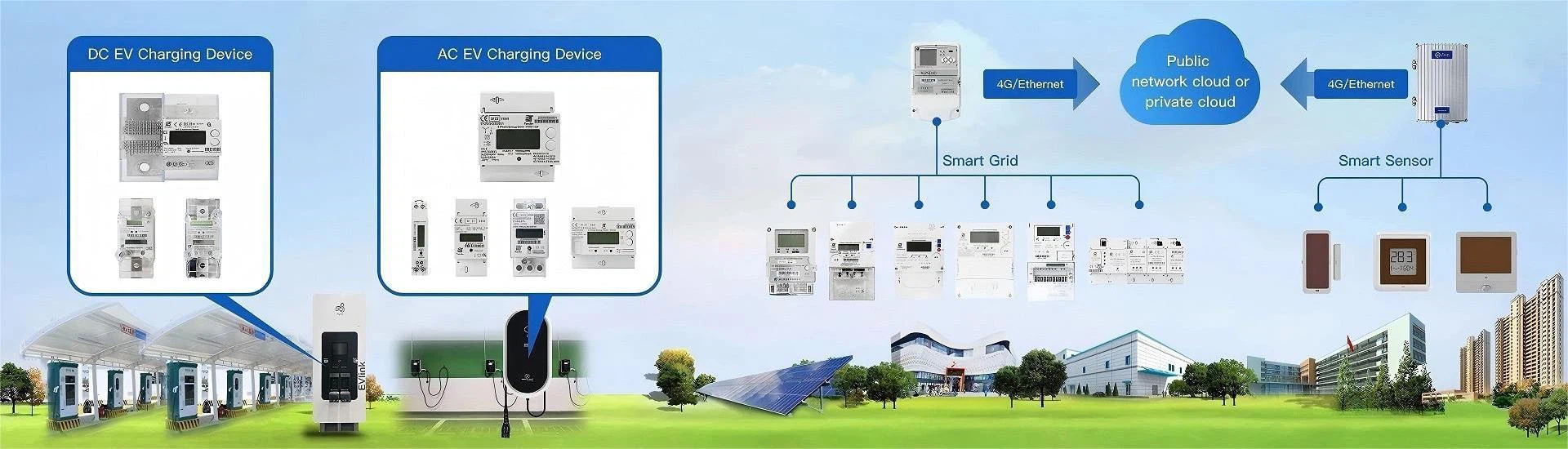
Electric energy meter is an instrument used to measure electric energy, also known as watt-hour meter, fire meter, kilowatt-hour meter, and refers to an instrument that measures various electrical quantities.
When using an electric energy meter, it should be noted that in the case of low voltage (not more than 500 volts) and small current (tens of amps), the electric energy meter can be directly connected to the circuit for measurement. In the case of high voltage or high current, the electric energy meter cannot be directly connected to the line, and must be used in conjunction with a voltage transformer or a current transformer.
How an energy meter works
When the electric energy meter is connected to the circuit under test, alternating current flows through the current coil and the voltage coil, and the two alternating currents generate alternating magnetic fluxes in their iron cores; Passing through the aluminum plate, an eddy current is induced in the aluminum plate; the eddy current is acted by a force in the magnetic field, so that the aluminum plate gets torque (active torque) and rotates. The greater the power consumed by the load, the greater the current passing through the current coil, the greater the eddy current induced in the aluminum plate, and the greater the torque that makes the aluminum plate rotate. That is, the magnitude of the torque is proportional to the power consumed by the load.
The greater the power, the greater the torque, and the faster the aluminum disc turns. When the aluminum disc rotates, it is acted by the braking torque generated by the magnet. The braking torque is opposite to the active torque. The magnitude of the braking torque is proportional to the rotational speed of the aluminum disc. The faster the aluminum disc rotates, the higher the braking torque. big. When the active torque and the braking torque reach a temporary balance, the aluminum disc will rotate at a constant speed. The electrical energy consumed by the load is proportional to the number of revolutions of the aluminum disc. When the aluminum plate rotates, it drives the counter to indicate the power consumption. This is the simple process of how the energy meter works.
Classification of commonly used electric energy meters
(1) Electric energy meters can be divided into DC electric energy meters and AC electric energy meters according to the circuits they use. AC electric energy meters can be divided into single-phase electric energy meters, three-phase three-wire electric energy meters and three-phase four-wire electric energy meters according to their phase lines.
(2) Electric energy meters can be divided into electrical-mechanical electric energy meters and electronic electric energy meters (also known as static electric energy meters, solid-state electric energy meters) according to their working principles. Electromechanical electric energy meters are used in AC circuits as ordinary electric energy measuring instruments, and inductive electric energy meters are commonly used. Electronic energy meters can be divided into fully electronic energy meters and electromechanical energy meters.
(3) Electric energy meters can be divided into integral electric energy meters and split electric energy meters according to their structure.
(4) Electric energy meters can be divided into active electric energy meters, reactive electric energy meters, maximum demand meters, standard electric energy meters, multi-rate time-of-use electric energy meters, prepaid electric energy meters, consumption electric energy meters and multi-functional electric energy meters according to their uses. table etc.
(5) Electric energy meters can be divided into ordinary installation electric energy meters (0.2, 0.5, 1.0, 2.0, 3.0 grades) and portable precision electric energy meters (0.01, 0.02, 0.05, 0.1, 0.2 grades) according to their accuracy levels.