

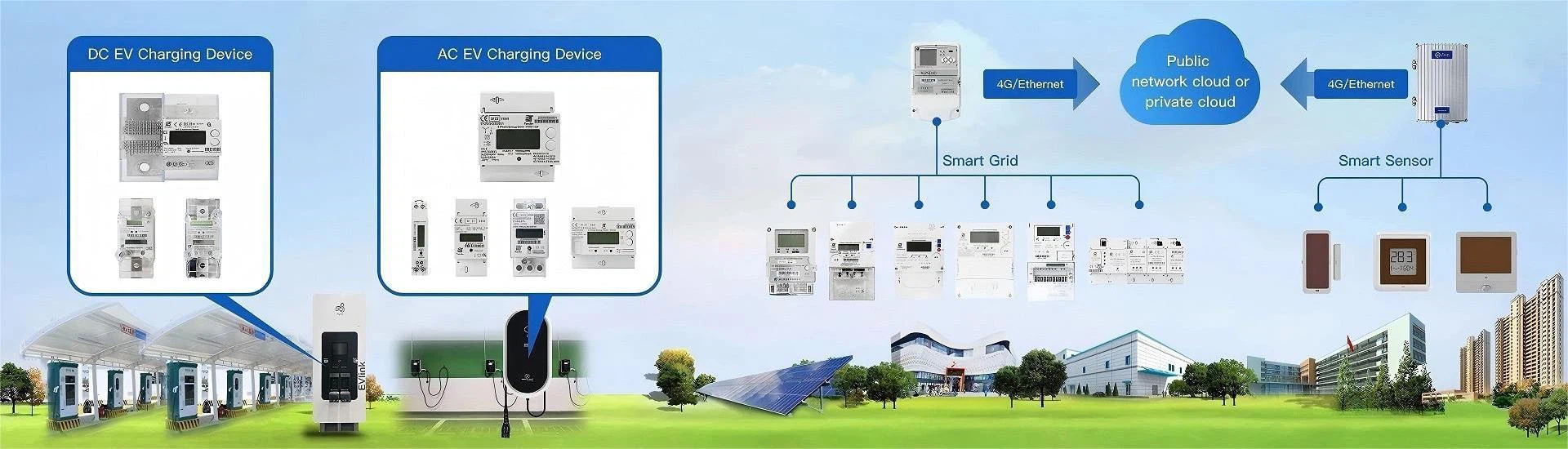
When selecting a Reallin Electron DJZ1226 DC smart energy meter, the minimum current (Imin), maximum current (Imax), and starting current (Ist) are relatively easy to understand. But what does the reference current (In/Ib) mean? What impact does the value of In have?

Reference current is sometimes simply understood as the energy meter's "comfort operating zone," the current at which measurement is most accurate.
However, the energy meter's error detection and accuracy calibration are actually performed using the reference current as a reference standard. As the word "reference" implies, it carries the meaning of "reference" and "comparison." Simply understanding the reference current as the "standard current" at which the energy meter measures most accurately and operates most stably is a simplistic view.

Section 6.1.2 of the "JJF1779-2019 Outline for Type Evaluation of Electronic DC Energy Meters" specifies the basic maximum permissible error, as shown in Table 4 below.
Table 4 Basic Maximum Permissible Errors at Reference Voltage
| Current Value (Direct Connection) | Current Value (Indirect Connection) | Basic Maximum Permissible Error (%) for Each Class of Energy Meter | |||
|---|---|---|---|---|---|
| 0.2 | 0.5 | 1 | 2 | ||
| 0.01Ib≤I<0.1Ib | 0.01In≤I<0.05In | ±0.4 | ±1.0 | - | - |
| 0.1Ib≤I≤Imax | 0.05In≤I≤Imax | ±0.2 | ±0.5 | - | - |
| 0.05Ib≤I<0.1Ib | 0.02In≤I<0.05In | - | - | ±1.5 | ±2.5 |
| 0.1Ib≤I≤Imax | 0.05In≤I≤Imax | - | - | ±1.0 | ±2.0 |
Notes:
Ib denotes the reference current of energy meters with direct current connection.
In denotes the reference current of energy meters with indirect current connection.
For energy meters with indirect current connection, the load current shall be converted into corresponding electrical parameters.
For example, the Reallin Electron DJZ1226 DC smart energy meter, with an accuracy class primarily of 0.5, features a built-in shunt and is an indirect current-connected type, with a reference current typically around 100A. Therefore, the calculations can be performed by referring to Table 4.
| No. | Model | Accuracy Class | Max Current | Min Current | Starting Current | Reference Current | RS485 Ports | External Terminals |
|---|---|---|---|---|---|---|---|---|
| 1 | J5003-AQI | Class 0.5 | 250A | 1.0A | 0.2A | 100A | 1 channel | Plug-in terminals |
| 2 | J5003-AQK | Class 0.5 | 300A | 1.0A | 0.2A | 100A | 1 channel | Plug-in terminals |
| 3 | J5003-AQS | Class 0.5 | 300A | 1.0A | 0.2A | 100A | 1 channel | Crimp terminals |
| 4 | J5003-AQN | Class 0.5 | 300A | 1.0A | 0.2A | 100A | 2 channels | Plug-in terminals |
| 5 | J5003-AQT | Class 0.5 | 400A | 1.0A | 0.2A | 100A | 1 channel | Crimp terminals |
| 6 | J5003-AQP | Class 0.5 | 400A | 1.0A | 0.2A | 100A | 1 channel | Plug-in terminals |
| 7 | J5003-AQQ | Class 0.5 | 400A | 1.0A | 0.2A | 100A | 2 channels | Plug-in terminals |
| 8 | J5015-AQS | Class 0.5 | 600A | 1.0A | 0.2A | 100A | 2 channels | Crimp terminals |
| 9 | J5015-AQP | Class 0.5 | 600A | 1.0A | 0.2A | 100A | 1 channel | Crimp terminals |
| 10 | J50159-FD | Class 0.5 | 1000A | 5.0A | 0.4A | 100A | 3 channels | Crimp terminals |
Where In is 100A, then ① 0.01In ≤ I < 0.05In is 1A ≤ I < 5A, with a maximum allowable error of ±1%.
Assuming Imax is 1000A, then ② 0.05In ≤ I < Imax is 5A ≤ I < 1000A, with a maximum allowable error of ±0.5%.
It can be deduced that, for the same accuracy, the smaller the reference current value, the smaller the error in the 1%In to 5%In current range…
Table 6 Starting Current Values of Energy Meters
| Accuracy Class | 0.2 | 0.5 | 1 | 2 | |
| Direct Current Connection | Forward | 0.002Ib | 0.003Ib | 0.004Ib | 0.005Ib |
| Reverse | 0.003Ib | 0.004Ib | 0.005Ib | 0.006Ib | |
| Indirect Current Connection | Forward | 0.001In | 0.002In | 0.003In | 0.004In |
| Reverse | 0.002In | 0.003In | 0.004In | 0.005In | |
Furthermore, based on the reference current, the starting current value for different accuracy classes can be calculated. The maximum permissible error can also be specified within the voltage variation range at the reference current.

Therefore, it can be seen that the reference current plays a significant role as a "reference," and it should not be simply understood as the current value with the best accuracy. It is a parameter value used in metering verification for error detection and accuracy calibration. However, relatively speaking, a smaller reference current value better reflects the meter's error value in the low current range.