

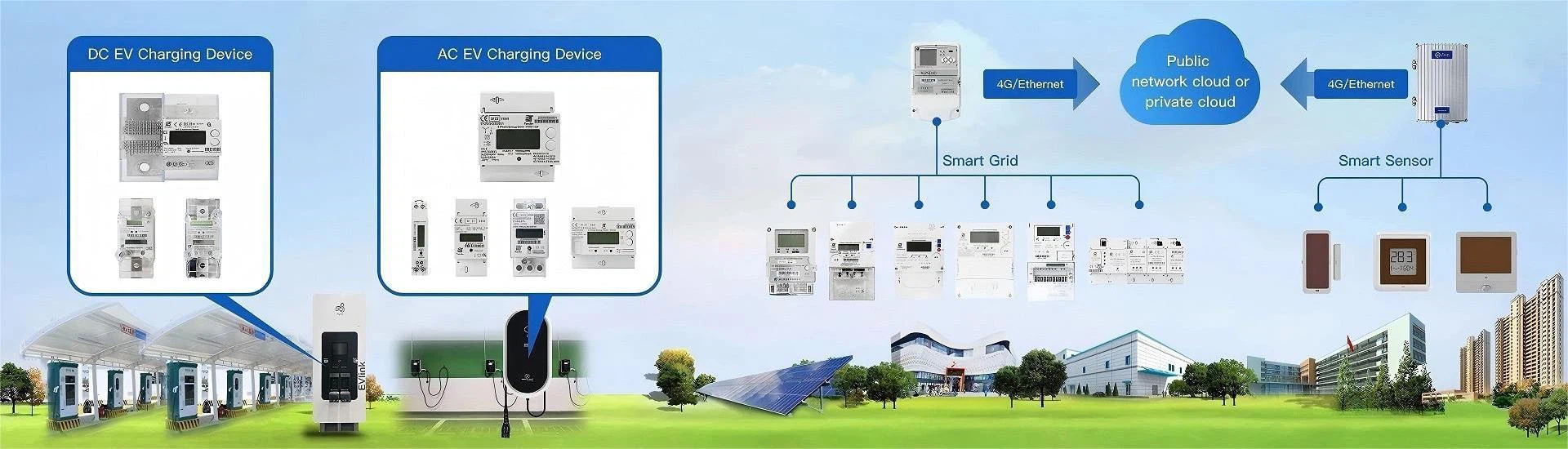
OCMF, OCPP, and SLIP are the "golden trio" for charging station data transmission – OCMF governs "how the data is structured" (standard format for metering data), OCPP governs "how the data is transmitted" (device communication rules), and SLIP governs "how the data is packaged" (underlying encapsulation method). These three work together to ensure that charging data is accurate, compatible, and traceable throughout its entire journey from generation to transmission.
Understand the functions of the three technologies.
OCMF: A "Standardized Shipping Label" for Charging Data
OCMF (Open Charge Metering Format) is an open charging metering format, equivalent to a customized "standardized shipping label" for charging data. Its core function is to standardize the format of charging data recorded by electricity meters (such as charging amount, charging time, and electricity price), and it also adds "digital signatures for anti-tampering." Whether it's a charging station or electricity meter from brand A or brand B, as long as they follow the OCMF standard, the data will look the same, and no one can tamper with it – just like the information on a shipping label is standardized and stamped with an anti-counterfeiting seal, allowing the recipient to understand it at a glance and preventing any alterations.
The core value lies in addressing the issues of "non-transparent and incompatible metering data," complying with metering regulations such as the EU MID certification, and providing a "legal basis" for charging and billing.
OCPP: The "Language of Communication" Between Charging Stations and the Backend System
OCPP (Open Charge Point Protocol) is an open charging point protocol, essentially the "common language" between charging stations and the central management system (CSMS). It defines a complete set of rules for communication between the two: for example, how the charging station "reports" the start/end of charging to the backend, how the backend "instructs" the charging station to start/stop, and what method is used for data transmission (long polling or WebSocket). Before OCPP, charging stations and backend systems from different manufacturers were like speaking different dialects, unable to communicate effectively; with OCPP, devices from any manufacturer can communicate smoothly.
The core value lies in breaking down "device barriers," supporting core functions such as remote management, firmware upgrades, and billing and reconciliation. Currently, OCPP 1.6 is the most widely used version, while 2.0+ also supports new features such as bidirectional charging.
SLIP: The "Protective Packaging" for Data Transmission
SLIP (Serial Line Internet Protocol) is a serial line internet protocol, acting like a "protective packaging" for data. Its core function is to encapsulate data received from the upper layer (such as data in OCMF format) into "data frames," facilitating transmission over low-speed serial lines (such as the RS-485 serial port commonly used in charging stations). Just like using tape to secure and mark the beginning and end of a package during shipping, SLIP adds special "start" and "end" markers to the data and handles special characters within the data to prevent confusion during transmission – ensuring accurate identification of data boundaries even with slight line noise.
The core value lies in its underlying hardware communication capabilities for charging stations, being lightweight and easy to implement, making it especially suitable for resource-constrained embedded devices such as electricity meters. It is widely used in DC electricity meters certified under the EU MID standard.
The core differences between the three
| Comparison Dimension | OCMF | OCPP | SLIP |
|---|---|---|---|
| Core Position | Data format standard ("what") | Communication protocol rules ("how") | Underlying encapsulation method ("wrap") |
| Key Function | Unify metering data structure; prevent counterfeiting and tampering | Enable bidirectional communication between devices and backend | Adapt to serial links; ensure complete data transmission |
| Application Layer | Data content layer ("write content") | Communication protocol layer ("set rules") | Link physical layer ("do packaging") |
| Core Features | Encryption & signature; comply with metering specifications | Cross-brand compatibility; support remote management | Lightweight & simple; adapt to low bandwidth |
| Typical Scenarios | Electric energy meter data output; billing settlement certificate | Interaction between charging piles and CSMS; remote control | RS-485 serial port transmission; embedded device communication |
How do these three components "collaborate to complete a charging data transfer"?
The process can be easily understood using the analogy of "sending a package":
1. Data Generation and "Filling out the Form" (OCMF is responsible): When you plug in the charging cable, the electricity meter records data such as charging amount (20kWh), charging time (1 hour), and electricity price (1.5 yuan/kWh) in real time. OCMF organizes this data into a "unified shipping form" according to a standard format, and adds a digital signature (anti-counterfeiting seal) to ensure the data is authentic and tamper-proof.
2. "Packaging" the Data (SLIP is responsible): This "shipping form" (OCMF data) needs to be transmitted through the charging station's serial line. SLIP acts like a packer, adding "start and end markers" to the data (equivalent to the sealing tape on the package). If there are special characters in the data, it will also perform escape processing (to avoid confusion in the packaging), encapsulating the data into a "data packet" suitable for line transmission.
3. "Transporting" the Data (OCPP is responsible): The packaged data packet needs to be sent from the charging station to the backend management system. OCPP is the "traffic rule" for this transportation – it specifies which channel the data travels through (long polling or WebSocket), how to verify identity (TLS encryption), and how to handle problems (error retransmission). According to OCPP rules, the data packet can smoothly reach the backend without being rejected due to "different equipment brands."
4.Backend "Unpacking and Verifying the Form": The management platform first unpacks the data packet using SLIP's rules, then verifies the digital signature using OCMF's public key (checking the anti-counterfeiting seal), and finally parses the OCMF formatted data to generate a bill – the entire process is seamless, with no risk of data corruption or tampering.
Simply put: OCMF creates the "data," SLIP packages the "data," and OCPP transports the "data." All three are indispensable and together form a complete data transmission chain for charging.
Why are these three considered an "essential combination"?
1. Guaranteed Compatibility: Different brands of charging stations, electricity meters, and management platforms can seamlessly connect as long as they all support these three standards. For example, a charging station from manufacturer A can directly transmit OCMF data, encapsulated via SLIP and transmitted via OCPP, to manufacturer B's management system without requiring additional development of adaptation tools.
2. Compliance Support: OCMF complies with EU MID and German Mess- & Eichrecht metering regulations, SLIP is compatible with MID-certified electricity meters, and OCPP supports encrypted data transmission. The combination of these three ensures the legal validity of charging billing and avoids disputes over "exorbitant charging fees."
3. Low Cost and High Efficiency: SLIP is lightweight and easy to implement, requiring no complex hardware; both OCPP and OCMF are open standards, eliminating the need for patent fees and significantly reducing manufacturers' research and development and operating costs.
Summary: What are the core values of these three technologies?
Before these three technologies, the charging station industry faced problems of "disorganized data, difficult communication, and risky transmission": different devices had diverse data formats, cross-brand devices could not communicate, and data was easily lost or tampered with during transmission.
The combination of OCMF, OCPP, and SLIP effectively solves these three major pain points:
● OCMF ensures that data is "standardized and tamper-proof";
● OCPP enables "barrier-free and controllable" communication;
● SLIP ensures "adaptable and lossless" transmission.
With the development of the electric vehicle charging industry, these three standards have become the mainstream configuration for charging stations in the EU and even globally, and are the core technological foundation for ensuring a fair charging experience and efficient industry collaboration.