

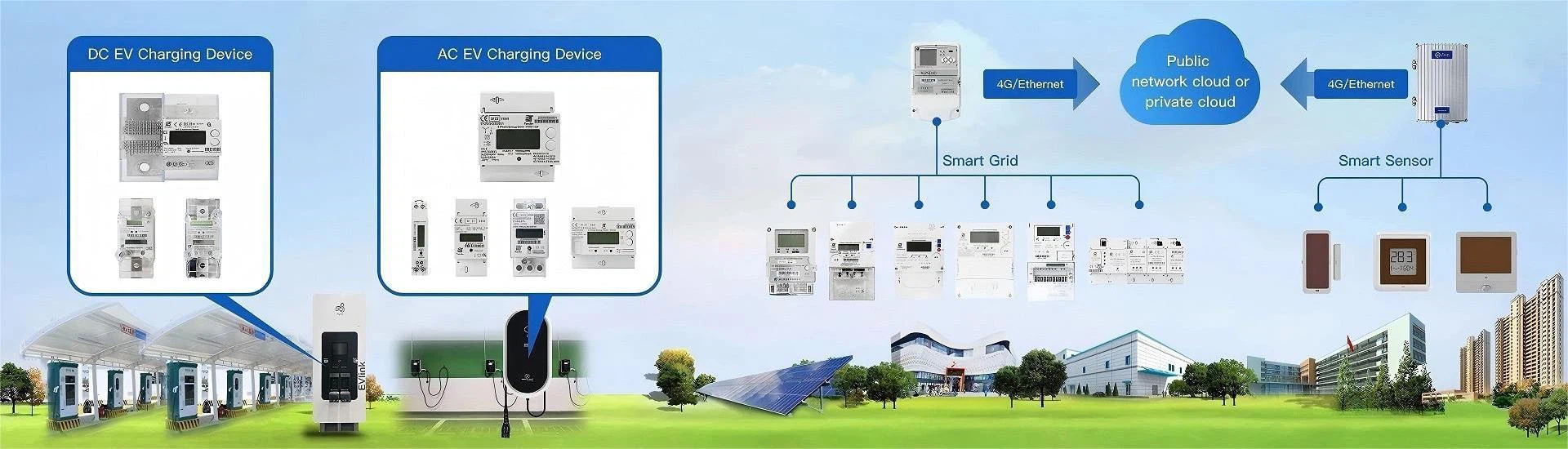
The core function of an electricity meter is not only to measure the magnitude of the load power but also to reflect the duration of power usage. To achieve this goal, the meter needs to convert the large current from the power grid into a small signal for processing by the internal metering chip.

The core function of an electricity meter is not only to measure the magnitude of the load power but also to reflect the duration of power usage. To achieve this goal, the meter needs to convert the large current from the power grid into a small signal for processing by the internal metering chip.
Why can't we directly measure large currents?
This is mainly due to safety and practical considerations. Household and industrial electrical currents can reach tens or even hundreds of amperes. Directly measuring such large currents would not only place a huge burden on the measuring instrument itself but also pose serious safety hazards.

Current sensing components act like "current scalers" for electricity meters; they proportionally reduce the current to a level suitable for the measuring circuit to process. This conversion must be as accurate as possible, as any error will directly affect electricity bill calculations.

Currently, the main current sampling components used in AC energy meters include shunt resistors (referred to as shunts) and current transformers (CTs). The differences in advantages and disadvantages between current transformers and shunts stem from their working principles and structural designs, and the choice between them requires careful consideration based on the specific application requirements:
| Comparison Dimension | Shunt Resistor | Current Transformer (CT) |
|---|---|---|
| Advantages | 1. Low cost, simple structure, significantly reduces overall system cost; 2. Extremely small volume, no magnetic components or saturation issues; stable small-current field measurement, suitable for compact space designs; 3. Within the rated current range, provides accurate voltage signals with no electromagnetic interference concerns. |
1. Inherently provides high-voltage isolation; primary and secondary sides are physically isolated; 2. Excellent accuracy and linearity; suitable for wide current ranges and wide temperature operating ranges, with strong internal stability; 3. Flexible measurement range: by adjusting the turns ratio, can adapt from tens of amperes up to tens of kiloamperes, facilitating standardized power-meter design. |
| Disadvantages | 1. High-voltage applications require additional isolation circuitry, increasing design complexity and cost; 2. Not suitable for high-current or wide temperature-fluctuation environments. |
1. Higher cost, larger size and weight; customized specifications increase cost further; 2. Susceptible to electromagnetic interference; the magnetic core may be affected by external magnetic fields; high-voltage pulse interference can cause saturation and degrade measurement accuracy, requiring additional shielding design; 3. Complex manufacturing process with strict requirements for core materials and winding precision. |

The key principle in selecting current sampling components for AC energy meters is "prioritizing suitability for the application scenario while considering both accuracy and cost." For high-voltage, high-current industrial and power system applications requiring electrical isolation, current transformers are the preferred choice. For low-voltage, low-current, and cost-sensitive consumer and miniature instrument applications, shunts can be used, provided that proper heat dissipation and isolation designs are implemented.