

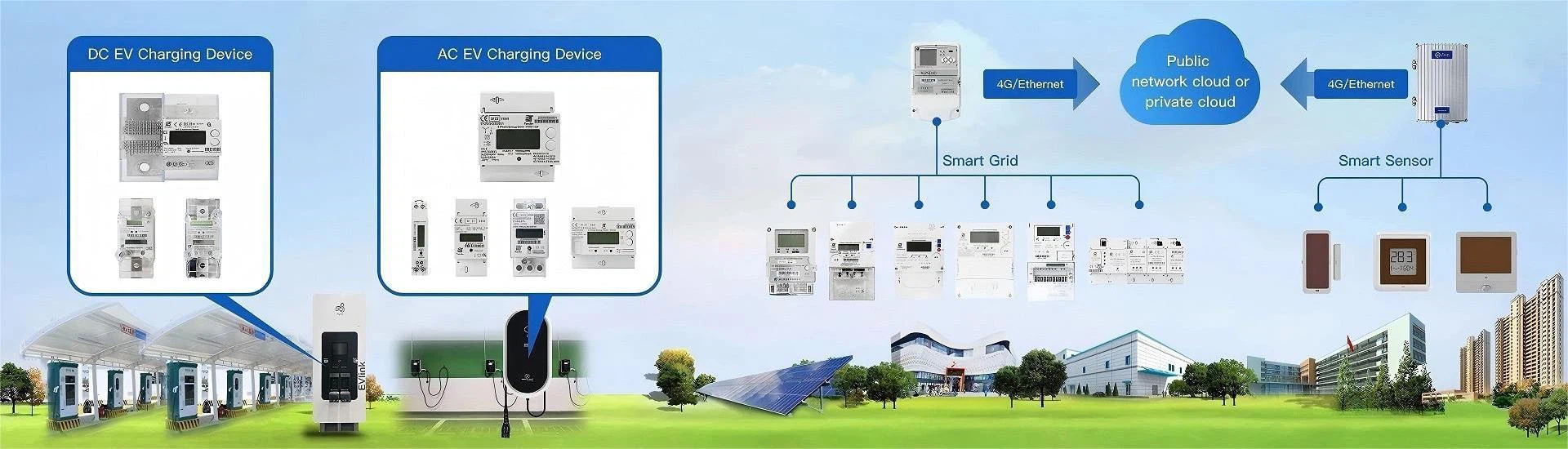
As an important part of the power system, smart meters provide users with real-time energy consumption monitoring and accurate billing functions. At present, many regions use a 2-rate structure for electricity billing so that different electricity price strategies can be adopted during peak and off-peak hours. However, with the development of the energy industry and changes in electricity consumption patterns, the demand for more refined billing strategies is also increasing. Therefore, smart meters are expanded from 2 rates to 4 rates to meet the refined billing needs of different time periods and load types. By adding more tariff levels, power companies can better control and manage electricity use, encourage users to use electricity during off-peak hours, and promote the rational use of energy. Expanding smart meters from 2 rates to 4 rates has an important impact on energy management and billing systems. First, the 4-rate structure provides greater flexibility, allowing power companies to formulate more refined billing strategies to cope with different load demands and market changes. Second, the 4-rate structure can encourage users to use electricity during low-price periods, reduce energy consumption peaks, reduce grid load pressure, and further improve energy efficiency. By improving the hardware and software levels of smart meters, as well as updating related systems and interfaces, a smooth migration from 2 rates to 4 rates can be achieved.
Keywords: smart meter; multi-rate billing; user interface; communication protocol
Content
1 Overview of smart meter technology
1.1 Definition and functions of smart meters
1.3 Advantages and limitations of 2-rate billing
2.1 Definition and advantages of 4-rate billing
2.2 Application areas and needs of 4-rate billing
2.3 Challenges and technical requirements of 4-rate billing
3 Migration methods for smart meters from 2 rates to 4 rates
3.1 Hardware upgrade and support
3.2 Firmware Update and Algorithm Improvement
3.3 Database Update and Management
3.4 User Interface Update and Interaction Design
3.5 Communication protocol update and adaptation
3.6 Testing and verification methods
1 Overview of smart meter technology
1.1 Definition and functions of smart meters
Smart meters are advanced power measurement devices that can measure and record power consumption. Compared with traditional meters, smart meters have more functions and intelligent features, can monitor power usage in real time, provide accurate metering data, and can exchange data with other systems through communication networks to achieve remote meter reading and remote control.
1.2 Rate billing structure
Currently, many regions use a 2-rate billing structure, which divides a day into peak and off-peak hours, and then uses different electricity prices for each. Peak hours are usually busy hours during the day, while off-peak hours are other time periods. This billing structure can encourage users to use electricity during off-peak hours to balance the grid load and reduce energy consumption peaks.
1.3 Advantages and limitations of 2-rate billing
The 2-rate billing structure has some advantages, including a simple and easy-to-understand rate model and adaptability to user usage habits. In addition, for power companies, 2-rate billing is also easier to implement and manage. However, the 2-rate structure also has some limitations, such as the inability to meet the billing needs of different load types in different time periods. In addition, with the changes in energy consumption patterns and the popularization of renewable energy, more rate levels are needed to adapt to more complex billing strategies. The development of the energy industry and the advancement of technology have also increased users' demand for the functionality and billing flexibility of smart meters. In order to meet these needs, expanding smart meters from 2 rates to 4 rates has become an important research direction.
2.1 Definition and advantages of 4-rate billing
4-rate billing is a billing structure that divides a day into different time periods and uses different electricity prices. Compared with 2-rate billing, 4-rate billing provides more rate levels, making energy consumption management more refined and flexible. Through more detailed rate settings, power companies can more accurately reflect the energy supply and demand relationship and market changes, thereby formulating more optimized energy billing strategies.
2.2 Application areas and needs of 4-rate billing
4-rate billing has a wide range of needs in multiple application areas. For example, for industrial enterprises, according to the characteristics of the production process and energy consumption requirements, a day can be divided into different time periods and different electricity prices can be used to better encourage the optimization of energy consumption; for residential users, 4-rate billing can provide more choices and flexibility to enable reasonable energy management based on personal energy usage habits and needs.
2.3 Challenges and technical requirements of 4-rate billing
The implementation of a 4-rate billing structure requires overcoming some challenges and meeting some technical requirements. First, smart meters need to have higher computing power and storage capacity to handle more rate data and complex billing algorithms. Second, related databases and systems also need to be updated and upgraded to adapt to the data management and exchange requirements of 4 rates. In addition, the user interface and communication protocol also need to be updated and adjusted accordingly to support user operations and communication with other systems. By introducing a 4-rate billing structure, smart meters can better meet the energy management needs of different users and industries.
3 Migration methods for smart meters from 2 rates to 4 rates
3.1 Hardware upgrade and support
Before expanding smart meters from 2 rates to 4 rates, the hardware capabilities and compatibility of the current meters need to be evaluated. If the hardware support of the meter is extended to 4 rates, hardware upgrades may be required, such as replacing the processor or adding additional memory, to ensure that the meter can handle more rate data and meet complex computing requirements.
3.2 Firmware Update and Algorithm Improvement
Updating the firmware of the meter is a key step in implementing 4-rate billing. Firmware update includes writing and loading new firmware programs to support the 4-rate billing structure and update the billing algorithm. The new firmware program should be able to identify and process the 4-rate tiers and perform accurate billing calculations based on the set time period and rate parameters.
3.3 Database Update and Management
Smart meters usually exchange and store data with related databases. In order to support 4-rate billing, the database needs to be updated and managed accordingly, including adding new fields or tables to store and manage 4-rate related data, such as rate time period, rate price, and rate priority information.
3.4 User Interface Update and Interaction Design
Updating the user interface of the smart meter is key to ensuring that users can correctly set and understand 4-rate billing. The user interface should reflect the new rate tiers and rate parameters and provide an intuitive way for users to set and query. The interaction design should be simple and clear to help users easily switch between different rate modes and view related billing information.
3.5 Communication protocol update and adaptation
If the smart meter exchanges data with other systems through the communication network, the communication protocol needs to be updated to support 4-rate data transmission and exchange. This may require consultation and adjustment with the power company or related suppliers to ensure seamless integration between the meter and other systems and the correctness of data transmission.
3.6 Testing and verification methods
In the final stage of the migration process, it is necessary to fully test and verify the smart meter. The test method should cover all aspects, including the accuracy of rate calculation, the reliability of data exchange, and the normal operation of the user interface. The verification process should be compared with the existing 2-rate system to ensure that the meter migrated to the 4-rate can work properly and provide correct billing results.