



Abstract:In order to ensure the accuracy ofthe outputphase voltage ofthe AC side ofthe ac- tive power filter, to effectively carry out harmonic tracking compensation and to improve power quality, the busvoltageon the DC side mustbe keptsufficiently stable and the reason- able value of the capacitance on the DC side is crucial.The design method ofbus supportca- pacitor capacity is derived based on instantaneous power balancing, taking into account the constraints of bus voltage, capacitor ripple current and capacitance loss, to effectively sup- press voltagefluctuationson theDC side and maintain compensation performance, while avoi- ding bus capacitoroverdrawing and reducing hardware costs, and the effectivenessofthe pro- posed design method is verified by simulation and experiment.
Keywords:active power filter; bus voltage; capacitance loss; instantaneous power; capacitor capacity
Content:
2. Main circuit structure and compensation principle
3. Bus capacitor design
3.1 Analysis of bus capacitor voltage value
3.2 Analysis of capacitor ripple current and capacitor loss
4. Experimental results and analysis
1. Article Purpose
With the widespread application of power electronic devices such as switching power supplies in the fields of communication, home and industry, the nonlinear load in the power grid has increased significantly. During the operation of power electronic devices, a large amount of harmonics are injected into the power grid, causing problems such as overheating and insulation aging of electrical equipment, and easily causing relay protection malfunctions that endanger the safety of power grid operation. In view of the above problems, this paper combines the influence of bus voltage on harmonic suppression, derives the quantitative relationship between bus current, parallel capacitance and capacitor loss, and constructs the constraint relationship between instantaneous voltage, ripple and system power on the DC side capacitor value on the basis of power balance, and then obtains the capacitance value range. The correctness of the calculation method is verified by experiments.
2. Main circuit structure and compensation principle
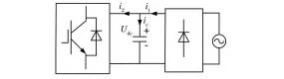
The system adopts a three-phase four-wire topology structure. The DC side midpoint is not connected to an inductor. The AC side is connected to the three-phase power supply through an interface inductor. The DC side is connected to a support capacitor to buffer harmonic energy and stabilize the bus support voltage.

3.1 Analysis of bus capacitor voltage value
To achieve complete inversion, the active power filter should make the output voltage on the inverter side greater than the peak value of the phase voltage on the grid side. When the midpoint of the capacitor is short-circuited to the grid side, the relationship between the output voltage on the inverter side and the capacitor voltage on the DC side can be obtained by using the KVL law in the loop:

The phase voltage of the public distribution network is 220 V. Considering that the transformer output voltage is 10% higher than the rated value and ignoring the influence of harmonics, the phase voltage peak value is:
Ex = 110% ∗ 220 ∗ 2 = 342.
3.2 Analysis of capacitor ripple current and capacitor loss
The energy exchange between the grid side and the load is mainly achieved through busbar capacitance. If the capacitance value is too small, the voltage stabilization effect cannot be achieved, and the voltage pulsation on the DC side is large; if the capacitance value is too large, although it is beneficial to reduce the voltage pulsation, it is accompanied by a decrease in the equivalent series resistance, allowing the ripple current to increase, which increases the system power loss and the capacitor heating, affecting the working life of the capacitor.
4. Experimental results and analysis
The model was established in Matlab/Simulink simulation software, and the simulation parameters were set as follows: three-phase grid voltage 220 V/50 Hz; three-phase load was uncontrolled rectifier with RLC load, R = 25 Ω, L = 1 mH, C = 2 mF; the filter inductance Lf = 2.5 mH between the APF and the grid, DC side voltage U dc = 730 V, and DC side capacitance 2 mF .
5.Conclusion
This paper describes the design process of the DC side capacitor value of the high-power parallel active filter, and proposes a method to obtain the DC side capacitor value under the constraints of DC side voltage, ripple current and output power based on instantaneous power balance, so that the DC side capacitor design is more accurate and the value is more reasonable. It can also design the DC side capacitor under different compensation power, allowable ripple or DC side setting value. The experiment verifies the correctness and effectiveness of the design. The proposed design method and engineering experience have certain reference significance for the research and application of bus capacitor design of other active filter systems.