

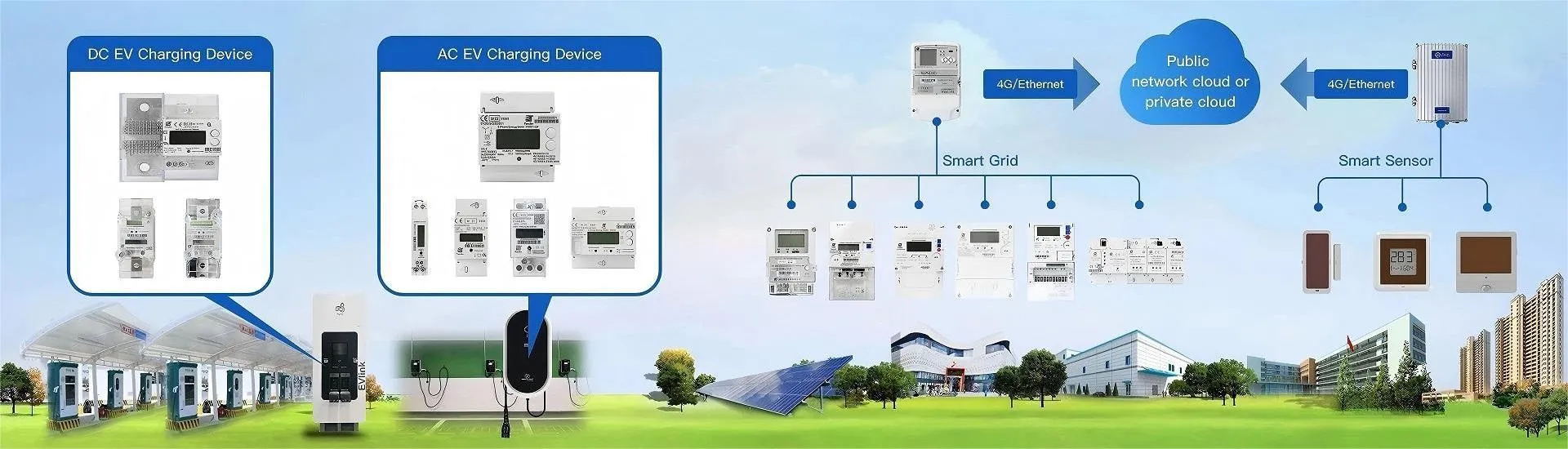


In order to adapt to the new grid form and meet user needs, and to better serve the social economy, the concept of "smart grid" was proposed. Since then, countries have gradually carried out theoretical research and pilot projects related to smart grids, and a smart grid boom has been set off around the world. State Grid Corporation of China has set up a smart grid department to promote the construction of smart grids in my country. At present, "smart grid" has become one of the hot words about the future development direction of the grid, and the advanced measurement system provides a corresponding transition process for the intelligentization of the grid. In recent years, due to the development of communications and the demand for smart grids, the power industry has continuously increased the coverage of AMI.
Content
2.4 Metering Data Management System
3.1 Advantages and functions of AMI
3.3 Progress of AMI application demonstration
1. Concept of AMI
Advanced Measurement Infrastructure (AMI) is a complete network processing system used to measure, collect, store, analyze and use user electricity consumption information. It consists of smart meters installed at the user end, metering data management system located in the power company, communication system connecting them and indoor network in the user's residence. Specifically, the advanced measurement system can be divided into four aspects: smart meters, two-way communication network, user indoor network, metering data management system, as shown in Figure 1.

2. Components of AMI
As the most critical measuring device in the advanced measurement system, the smart meter is responsible for collecting user-side electricity information, power quality and other data and transmitting it to the power company through a two-way communication network. It is the interface for users to interact with the power company. The basic structure of the smart meter is shown in Figure 2. Compared with traditional electromechanical meters, smart meters have been significantly improved. Their outstanding functions include:

1) Users can read real-time metering information;
2) Support time-of-use electricity prices;
3) Provide users with real-time electricity price information;
4) Realize intelligent load control and perform remote setting, connection, and shutdown;
5) Have a multi-rate metering mode to record the user's electricity consumption information in various time periods, and provide data analysis support for users to better understand their own electricity consumption habits and participate in various demand response projects;
6) Provide technical support for the integration of renewable energy power generation into the large power grid and provide related billing functions;
7) Remotely monitor power quality. Power companies can obtain user-side power information through smart meters;
8) Quickly locate and respond to system failures
The two-way communication network allows users to obtain real-time operation status and electricity price information of the power grid, changing the mode of the power company data center to obtain data from users in a one-way manner. The smart meter statistical information is transmitted from the meter to the power company data center several times a day, providing data support for the reliable operation of various advanced applications. The AMI communication network can generally be divided into three parts: wide area backbone communication network, local branch communication network and home LAN, as shown in Figure 3.

Power line carrier communication and wireless communication are usually selected as communication network channels. Power line carrier communication has obvious advantages (no wiring required), high market recognition, and is constantly expanding its application areas. It is currently widely used in electric vehicle charging piles, smart home appliances/smart home control, smart lighting, energy efficiency management and monitoring, smart buildings and other fields.
The user's indoor network (HAN) is a comprehensive network formed by interconnecting various smart interconnected devices of users. It can connect multiple computers, mobile phones, cameras, home security alarm systems, smart appliances and other digital devices. The various information of the user's indoor network is collected into smart grid devices (such as smart meters), and then the user's indoor network and the smart grid are interconnected through a two-way communication network, so that these devices can be controlled.
2.4 Metering Data Management System
The metering data management system (MDMS) is a database with analysis tools, located in the data center, used to store, analyze and manage users' metering and billing information. MDMS smart meters are interconnected and store and process metering data sent by meters. Power companies can obtain system electrical parameters by analyzing various data information in MDMS, and realize advanced application functions such as power theft analysis, fault prediction, stable operation, and network recovery. A basic function of MDMS is to confirm, edit and estimate AMI data to ensure that the data flow to the information system is complete and accurate when the communication network is interrupted or the user side fails. The joint operation diagram of each part of AMI is shown in Figure 4.

3. AMI application research
3.1 Advantages and functions of AMI
The establishment of AMI realizes the two-way interaction between the grid and the user, adapts well to the new grid mode, and meets the needs of users for two-way electricity metering under the rapid development of distributed power generation. Under the current development model, the advanced measurement system AMI can mainly achieve the following functions:
1) Users can understand the real-time electricity price and electricity information, which improves the initiative of users to participate in the operation of the grid;
2) Provides a platform for users who install distributed power sources and energy storage devices to access the power market. At the same time, it provides convenience for power companies to reasonably guide their operations and improve power flow distribution;
3) Through measurement information, it can help power companies evaluate the use of equipment, optimize their operating status, and extend the service life of equipment;
4) Conduct power theft detection, fault detection and power quality management to achieve self-healing of the power grid;
5) Provide users with demand response (DR) policy information such as time-of-use electricity prices to guide their active participation, which is conducive to the "peak shaving and valley filling" of the power grid. At the same time, the calculation method of the GSL algorithm (GNU scientific library, GSL) is combined to monitor and respond to the process and promote the smooth operation of the power grid.
1). Optimize the comprehensive business capabilities of enterprises
2). Reduce construction investment in all aspects
3). Reform and innovate asset management level
4). Trigger power demand response
5). Improve system operation efficiency
6). Promote social equity
7). Improve capital operation capabilities
8). Promote scientific and technological innovation and progress
3.3 Progress of AMI application demonstration
Based on the important benefits of AMI technology in energy conservation, emission reduction and low load response, many government departments or organizations have formulated legislation to promote the implementation of AMI technology. The main demonstration projects in various countries are shown in Table 1.
| Table 1 Key national demonstration projects | |
| Country | Project Name |
| France | Linky Project |
| Italy | Telegestore Project |
| United States | Ohio Smart Grid Demonstration Project |
| South Korea | Jeju Island Smart Grid Demonstration Project |
4. Conclusion
1) Learn from foreign AMI development experience to develop an AMI standard system.
2) Reallin has developed smart meters with different functions according to different user needs. In order to avoid waste of resources, it is necessary to reasonably consider the application of existing software and hardware resources to develop smart meters.
3) Promote the data integration and upgrading of different industries (water, gas, heat, cold, etc.) and advanced measurement systems.
4) User privacy protection should also be continuously strengthened and improved with the development of the system to promote user trust in power companies.