

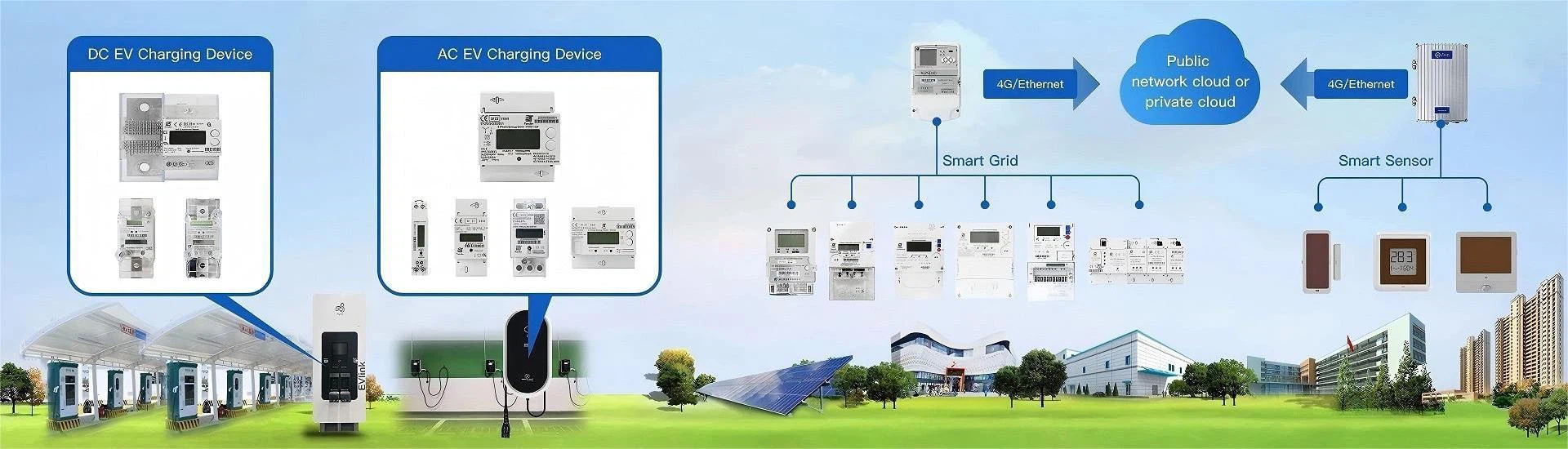
Electricity meters are very common, but have you ever wondered how the "standard equipment" used to calibrate these meters is itself tested? Especially in the context of the widespread adoption of megawatt-level ultra-fast charging stations for new energy vehicles, how can a full-power calibration of an electricity meter be performed when it would consume 1000 kilowatt-hours of electricity in just one hour?
Are electricity meters always tested under actual load conditions? In the field of electricity metering, we cleverly utilize "virtual load" technology to solve this problem.
Are all electricity meter verifications performed with a "real" load?
Conclusion: Not necessarily. Although, in principle, driving the electricity meter with a real load is the most straightforward testing method, in practice, especially in scenarios involving high voltage, high current, or high precision requirements, the "simulated load method" is the mainstream approach.

For the above UBS electronic megawatt fast-charging station energy meter (1000V/1000A), if real-load testing is performed:
• Power: P = U*I = 1000V * 1000A = 1,000,000W = 1MW
• Energy consumption: Running at full load for one hour would indeed consume 1000 kilowatt-hours of electricity and require a massive cooling system.
This is extremely uneconomical and difficult to implement in laboratory or field calibration. Therefore, for both AC and DC energy meters, the "phantom load testing method" (also known as the "standard meter method" or "power source method") is the core technique for high-power calibration.
Real load testing vs. simulated load testing: What are the differences?
The two methods can be compared to "weighing something":
• Real Load Test: This is equivalent to placing a standard weight of known mass (a real physical load) on the scale (electricity meter) to see if the scale is accurate.
• Virtual Load Test: This is equivalent to simulating a "fake" load signal through a circuit, telling the electricity meter that "electricity is currently being consumed," but in reality, not that much electricity is actually being consumed.
Real Load Verification Method
This method uses actual physical components (such as resistors, inductors, and capacitors) as the load:
• Principle: A standard energy meter and the meter under test are connected in series in the same actual load circuit, allowing them to operate under the same voltage and current. The difference in their readings is then compared.
• Application Scenarios: Primarily used for simple on-site verification, testing of older induction-type energy meters, or in small laboratories without high-precision programmable power supplies.
Virtual Load Verification Method
This is the mainstream method for modern energy meter verification, especially for electronic energy meters and DC energy meters:
• Principle: A programmable power source is used to independently provide voltage and current. The voltage circuit and current circuit are physically separated (the voltage circuit has very low current, and the current circuit has very low voltage). Precise electronic circuits simulate various operating conditions required for the normal operation of the energy meter (such as different power factors and different current ratios).
• Application Scenarios: Almost all laboratory full-performance verification, factory inspection, and high-precision on-site calibration.

Comparison Of The Two Testing Methods
| Comparison Dimension | Actual Load Calibration Method | Virtual Load Calibration Method |
|---|---|---|
| Energy Consumption | Extremely high. Requires converting electrical energy into heat and mechanical energy, which is power-consuming and causes severe heat generation. | Extremely low. Only consumes tiny power of the equipment itself, energy-saving and environmentally friendly. |
| Equipment Volume | Bulky and heavy. Large currents require huge load boxes (similar to giant electric furnaces). | Compact and lightweight. Mainly composed of electronic components, easy to make portable. |
| Testing Accuracy | Relatively low. Affected greatly by load component aging and temperature drift, hard to adjust. | Extremely high. Can reach 0.05% or higher accuracy with good linearity. |
| Range Coverage | Limited. Difficult to accurately simulate small currents (e.g., starting current) or extreme overloads. | Full range. Can easily cover the entire range from starting current (0.4%Ib) to maximum current. |
| Safety | Relatively low. High current heat generation and short-circuit risks exist, with potential safety hazards. | Relatively high. Control circuit and power circuit are isolated, with complete protection mechanisms. |
1.Why does the virtual load method offer higher accuracy?
In the real load method, if the current coil has resistance, a voltage drop will occur, causing a change in the voltage across the voltage coil, thus introducing "additional errors." In the virtual load method, the voltage circuit and the current circuit are independent and do not interfere with each other, so there is no such additional error, and the measurement results are closer to the theoretical true value.
2.Why can the virtual load method measure megawatt-level power?
The virtual load calibration device (standard source) uses high-power transistors or IGBT modules internally to invert DC power into the required AC waveform, or to perform direct DC precision control. Unlike the real load method, it doesn't need to dissipate 1 MW of electrical energy as heat; instead, through closed-loop control, it can simulate the electrical characteristics of 1 MW with only a small amount of energy.

Summary
Let's return to the initial question: Are electricity meters always tested under actual load conditions?
No. Except for specific on-site simplified checks or testing of older meters, modern electricity metering (especially for high-voltage, high-current DC fast chargers) almost 100% uses the simulated load testing method.
Although the actual load method is "realistic," it has been gradually phased out or is only used as an auxiliary method due to limitations in energy consumption, size, and accuracy.
The simulated load method utilizes advanced electronic technology to achieve "small equipment handling large loads," ensuring the accuracy of national metrology standards while solving the energy consumption problem of testing megawatt-level fast charging stations.
The next time you see that small electricity meter on a charging station, remember that behind it lies a " 극한 pressure test" covering all operating conditions, simulated by high-tech electronic equipment.
