



Multifunctional Electric Meter
The Multifunctional Electric Meter is a high-performance power measurement device designed for industrial, commercial and smart building scenarios. It integrates accurate active/reactive power measurement, voltage/current monitoring, and energy statistics in one, with precision levels up to Class 0.5S for reliable data.
It supports multiple communication protocols like RS485 and NB-IoT, enabling remote reading, real-time data transmission, and remote parameter setting. Equipped with overload, overvoltage, and leakage alarms, it ensures safe power operation. Its compact DIN 35 rail-mounted design allows easy installation in distribution boxes, making it ideal for energy management, cost control, and smart grid integration.

Product Parameters
| Type | Three phase four wire electricity meter direct connection-D3001-AY |
| Voltage | |
| Nominal voltage Un | 3x277/480VAC |
| Voltage range | 0.8-1.15Un |
| Frequency | |
| Nominal frequency fn | 60 Hz |
| Frequency range | 0.98-1.02fn |
| Current | |
| Reference current Irer=Ib=10Ir | 5A |
| Maximum current Imax | 65A |
| Minimum current Imin | 0.25 A |
| Starting current Ist | 0.004I |
| Accuracy | |
| Active | Class B in compliance with DIN EN 50470-1/3 Class 1.0 in compliance with IEC62053-21 |
| Reactive | Class 2.0 in compliance with IEC62053-23 |
| Measuring Energy | |
| Two energy directions | +A/-A,+R/-R, |
| Reverse locking | +A,+R, |
| Meter constant | |
| LED-Output | 1000 imp/kWh,1000 imp/kvarh |
| Display | |
| LCD | 7 digit |
| Life cycle | >12 years |
| RS485-Data Interface | |
| Connector | Two screws type |
| Parameter | 9600/19200/38400 bps,8E1/8N1/8O1(parameters adjustable) |
| Communication protocol | Modbus RTU |
| Power Consumption | |
| Voltage circuit | <2W/10VA at Un |
| Current circuit | <4VA at Ib |
| Temperature Range &Humidity | |
| Typical Operation | -30℃ to+70℃ |
| Storage | -40℃ to+85℃ |
How to select a multifunctional electric meter with appropriate specifications based on the electricity usage scenario? How to determine the accuracy class and current rating?
It is necessary to match core parameters according to electricity load and scenario requirements. The current rating can be calculated as "power ÷ voltage". For medium and low load scenarios with current ≤ 80A, direct connection type (such as 10 (60) A) can be selected. For industrial high-load scenarios with current > 80A, it is necessary to use with a current transformer (such as 3×1.5 (6) A meter + corresponding transformation ratio transformer). The accuracy class is selected according to the scenario: high-energy-consuming equipment (such as air compressors) requires Class 0.5S (error ≤ ± 0.5%) to ensure accurate measurement; ordinary workshops can choose Class 1 to balance cost and demand; special scenarios such as laboratories require Class 0.2S. At the same time, it is necessary to match the voltage. For three-phase conventional scenarios, 3×220/380V is selected, and for high-voltage 10KV, a wide-range model is required.
How does the communication function adapt to the existing management system? What mainstream protocols and connection methods are supported?
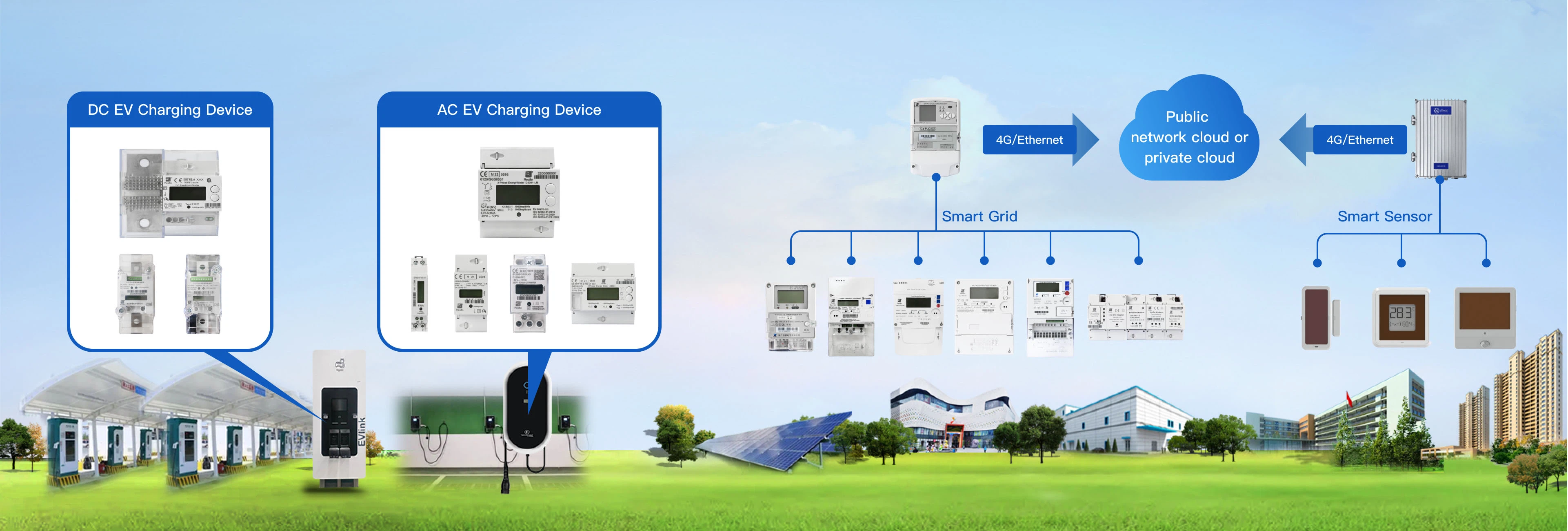
Communication adaptation needs to focus on protocol compatibility and connection methods. Mainstream protocols include Modbus-RTU (adapting to most industrial local area networks) and DL/T645-07 (compliant with industry standards such as the State Grid, supported by some three-phase meters). Connection methods are divided into wired and wireless: RS485 wired connection has low cost and is suitable for centralized distribution cabinet scenarios; 4G/NB-IoT wireless connection does not require wiring and is suitable for scattered workshops or remote meter reading needs. When purchasing, it is necessary to confirm that the meter protocol matches the existing system (such as the energy management platform) to avoid data intercommunication problems.
How to deal with common faults?
Reliability can be guaranteed through protection level, hardware configuration and functional design. For industrial scenarios, it is recommended to choose a dustproof and waterproof level of IP65 or higher, and core components should withstand a wide temperature range of -25℃~+55℃ (some models reach -40℃~+70℃). For common faults, priority should be given to models with overvoltage protection and dual RS485 interfaces (to avoid communication interruption caused by single port damage) and long-life built-in batteries (to prevent undervoltage garbled codes). At the same time, it should have an event recording function, which can record voltage loss and phase loss data, providing a basis for fault troubleshooting and power recovery. Some models support remote upgrade and parameter setting, reducing on-site maintenance costs.
Hot Tags: multifunctional electric meter, China, manufacturers, customized, bulk, low price, in stock


